4.2
46 verified reviews
About
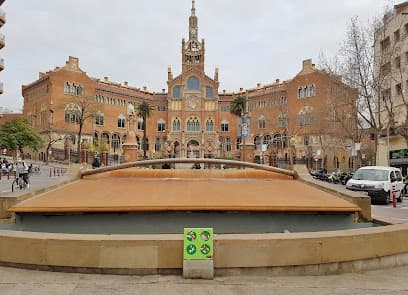
Most people in this city are doing it wrong. They’re back there, three blocks down, standing in a sweating, selfie-stick-wielding line at the Sagrada Família, waiting to pay forty euros to see a forest made of stone. They’re missing the point. If you want to understand how Barcelona actually breathes, you walk away from the cranes and the crowds. You take a stroll up Avinguda Gaudí, a diagonal slash through the rigid Eixample grid that acts as a relief valve for the neighborhood’s soul. At the very top, where the street finally gives up and hands the keys over to the magnificent, sprawling Hospital de Sant Pau, you’ll find this: the Font monumental de l'Avinguda Gaudí.
It isn’t some baroque explosion of bronze Neptunes and weeping cherubs. It’s a monolith. Designed by Màrius Quintana in 1985, it’s a massive, inclined block of stone that looks like it was dropped from a great height and just decided to stay there. Water doesn’t spray; it cascades, a steady, rhythmic sheet of liquid sliding over the grey surface. It’s 1980s Barcelona urbanism in a nutshell—uncompromising, functional, and slightly cold, but fundamentally honest. It was part of the city’s grand plan to reclaim the streets from the choking exhaust of Seat 600s and give them back to the people who actually live here.
Standing here, you’re caught between two worlds. Behind you is the long, pedestrianized stretch of the avenue, lined with cafes that—if you’re lucky—still serve a decent cortado without a side of tourist tax. In front of you is the Hospital de Sant Pau, Lluís Domènech i Montaner’s Modernista masterpiece. The fountain acts as a sort of aesthetic palate cleanser. After the dizzying complexity of the architecture surrounding it, this slab of stone is a reset button for your eyes. It doesn’t demand your adoration; it just provides a soundtrack of falling water to drown out the scooters buzzing along Carrer de Sant Antoni Maria Claret.
Look at who’s actually here. It’s not the folks with the laminated maps. It’s the old men in flat caps sitting on the surrounding benches, arguing about Barça’s latest disaster. It’s the nurses from the hospital taking a ten-minute smoke break, staring into the water with glazed eyes. It’s the pigeons who have claimed the top ledge as their own private sovereign territory. This is the real Eixample. It’s a place of transition, a gateway between the hyper-curated Gaudí trail and the lived-in reality of the Guinardó district.
Is it 'beautiful' in the way a postcard is beautiful? Probably not. But it’s a piece of the city’s DNA. It represents a moment when Barcelona decided to stop looking backward at its Gothic past and start building a modern, walkable future. It’s a sanctuary of white noise in a city that never shuts up. If you’re looking for a place to sit, think about your life choices, and watch the light hit the stone as the sun dips behind Tibidabo, this is it. Don't expect a gift shop. Don't expect a plaque telling you how to feel. Just sit down, shut up, and listen to the water hit the basin. That’s the sound of the city working.
Type
Tourist attraction
Duration
15-30 minutes
Best Time
Late afternoon for the best light and local atmosphere.
Features
Tourist attraction
Categories
ArchitecturePublic ArtUrban Design
Ticket Prices
Free Admission
No tickets required
Opening Hours
- MondayOpen 24 hours
- TuesdayOpen 24 hours
- WednesdayOpen 24 hours
- ThursdayOpen 24 hours
- FridayOpen 24 hours
- SaturdayOpen 24 hours
- SundayOpen 24 hours
Must-See Highlights
The cascading water effect on the inclined stone
The view looking down Avinguda Gaudí toward Sagrada Família
The contrast with the Hospital de Sant Pau entrance
Visitor Tips
Grab a coffee at one of the nearby non-chain cafes and use the fountain's benches to escape the Sagrada Família crowds.
Look for the historic Falqués lampposts further down the avenue for a contrast in styles.
Good For
Architecture enthusiastsBudget travelersLocal atmosphere seekersPhotography
Why Visit
Minimalist 1980s brutalist design by Màrius Quintana
Perfect acoustic buffer between the busy street and the pedestrian avenue
Strategic location connecting two UNESCO World Heritage sites
Nearby Landmarks
- Hospital de Sant Pau - 1-minute walk
- Sagrada Família - 10-minute walk
- Avinguda de Gaudí - 0-minute walk
Accessibility
- Fully accessible pedestrian area
- Flat paved surfaces
- Nearby accessible metro stations
Location
Av. de Gaudí, 76
Eixample, Barcelona
Nearby Hotels
Nearby Restaurants
In Eixample
ATTRACTION
Mural Margalef
Eixample
A towering splash of Mediterranean blue breaking the rigid geometry of Eixample, Joan Margalef’s mural is a visceral reminder that Barcelona’s soul isn't just in its museums.
0.0(0)
Tourist attraction
ATTRACTION
Mural Margalef
Eixample
A geometric middle finger to urban decay, this massive kinetic mural by Eduard Margalef turns a drab Eixample blind wall into a rhythmic, shifting explosion of optical art.
0.0(0)
Tourist attraction
ATTRACTION
Happy Foodies
Eixample
Forget the plastic-wrapped tourist traps; this is a deep dive into the grease, garlic, and soul of Catalan cooking where you actually learn to handle a knife and a porrón.
0.0(0)
Sightseeing tour agencyTour agency
Frequently Asked Questions
Is the Font monumental de l'Avinguda Gaudí worth visiting?
Yes, especially if you are already visiting the Hospital de Sant Pau. It offers a peaceful, minimalist contrast to the ornate Modernista architecture nearby and is a great spot for people-watching.
How do I get to the Avinguda Gaudí fountain?
Take the Metro L5 (Blue Line) or L2 (Purple Line) to Sagrada Família and walk up the pedestrianized Avinguda Gaudí, or take the L4 (Yellow Line) to Guinardó | Hospital de Sant Pau.
What is the best time to visit?
Late afternoon is best, when the sun hits the water and the local neighborhood life is at its peak on the surrounding benches.
Reviews
0 reviews for Font monumental de l'Avinguda Gaudí
No reviews yet. Be the first to share your experience!