4.5
6 verified reviews
About
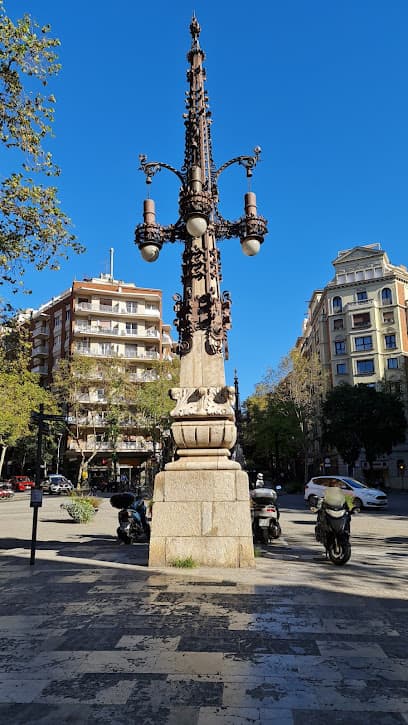
Most people walking down Avinguda Gaudí are doing one of two things: staring back at the melting stone of the Sagrada Família or marching toward the tiled domes of Hospital de Sant Pau. They’re usually dodging selfie sticks and overpriced 'artisan' gelato. But if you look up—really look up—you’ll see six wrought-iron sentinels that have seen more of this city’s drama than any tour guide. These are the Fanals of Avinguda Gaudí, and they are beautiful, jagged survivors of a Barcelona that almost got paved over.
Designed in 1906 by Pere Falqués i Urpí—the same guy who gave Passeig de Gràcia those famous white-tiled benches—these streetlights weren't originally meant for this tourist gauntlet. They used to stand at the intersection of Passeig de Gràcia and Diagonal, a spot known as the 'Cinc d'Oros' (the Five of Gold) because the arrangement of the lamps looked like the five-of-coins card in a Spanish deck. But by 1957, the city’s urban planners decided these modernist relics were 'obstructing traffic.' In the mid-century rush to make everything faster, flatter, and more boring, the lamps were dismantled and tossed into a warehouse to gather dust. It wasn't until 1985, when Avinguda Gaudí was pedestrianized, that someone had the sense to bring them back out into the light.
Standing on heavy stone bases, the ironwork is a raw, jagged showcase of the Modernisme style. It’s aggressive, organic, and deeply Catalan. The metal twists and curls like frozen smoke, topped with the city’s coat of arms and a crown. They don't make things like this anymore because it’s too expensive, too difficult, and requires too much soul. In a world of IKEA-flatpack urban furniture, these things are a middle finger to the temporary. They were built to last forever, even if the city government didn't always want them to.
The walk along Avinguda Gaudí itself is a bit of a trip. It’s a diagonal slash through the rigid grid of the Eixample, connecting two UNESCO World Heritage sites. On one end, you have Gaudí’s fever dream; on the other, Lluís Domènech i Montaner’s sprawling hospital complex. The streetlights act as the connective tissue. When the sun goes down and the orange glow hits the wrought iron, you can almost ignore the smell of frozen pizza from the nearby tourist traps. It’s a moment of genuine, old-world Barcelona grit and elegance.
Is it worth a dedicated trip? Maybe not if you’re only in town for twenty-four hours. But if you’re visiting the Sagrada Família—and let’s be honest, you are—don't just tick the box and leave. Walk the avenue. Touch the cold stone of the bases. Look at the detail in the iron that some blacksmith sweated over a century ago. It’s a reminder that even in the most crowded, commercialized parts of the city, there are still pieces of the real Barcelona hiding in plain sight. It’s free, it’s honest, and it doesn't require a reservation or a QR code. Just a pair of eyes and a bit of respect for the ghosts of the Cinc d'Oros.
Type
Tourist attraction
Duration
15-30 minutes
Best Time
At dusk, when the lamps are first lit and the crowds from the Sagrada Família begin to thin.
What People Say
sagrada familia(2)
Features
Tourist attraction
Categories
ArchitectureModernismeHistoryPublic Art
Ticket Prices
Free Admission
No tickets required
Opening Hours
- MondayOpen 24 hours
- TuesdayOpen 24 hours
- WednesdayOpen 24 hours
- ThursdayOpen 24 hours
- FridayOpen 24 hours
- SaturdayOpen 24 hours
- SundayOpen 24 hours
Must-See Highlights
The intricate wrought-iron Barcelona coat of arms at the top
The heavy carved stone bases
The view looking down the avenue toward the Sagrada Família framed by the lamps
Visitor Tips
Avoid the restaurants directly on the avenue; they are mostly overpriced tourist traps.
Look for the signature of Pere Falqués on the metalwork.
Combine this with a walk from Sagrada Família to Hospital de Sant Pau for a perfect Modernist afternoon.
Good For
Architecture buffsPhotography enthusiastsBudget travelersHistory lovers
Why Visit
Original 1906 Modernist ironwork by Pere Falqués
Historical survivors of the 'Cinc d'Oros' intersection
Visual link connecting the Sagrada Família and Hospital de Sant Pau
Nearby Landmarks
- 2-minute walk from Sagrada Família
- 8-minute walk from Hospital de Sant Pau
- 10-minute walk from Plaça de Gaudí
Accessibility
- Fully wheelchair accessible pedestrian avenue
- Flat paved surfaces
- Public outdoor space
Location
Av. de Gaudí, 155
Eixample, Barcelona
Nearby Hotels
Nearby Restaurants
In Eixample
ATTRACTION
Mural Margalef
Eixample
A towering splash of Mediterranean blue breaking the rigid geometry of Eixample, Joan Margalef’s mural is a visceral reminder that Barcelona’s soul isn't just in its museums.
0.0(0)
Tourist attraction
ATTRACTION
Mural Margalef
Eixample
A geometric middle finger to urban decay, this massive kinetic mural by Eduard Margalef turns a drab Eixample blind wall into a rhythmic, shifting explosion of optical art.
0.0(0)
Tourist attraction
ATTRACTION
Happy Foodies
Eixample
Forget the plastic-wrapped tourist traps; this is a deep dive into the grease, garlic, and soul of Catalan cooking where you actually learn to handle a knife and a porrón.
0.0(0)
Sightseeing tour agencyTour agency
Frequently Asked Questions
Is Fanal Avinguda Gaudí worth visiting?
Yes, especially if you are already visiting the Sagrada Família or Hospital de Sant Pau. These historic 1906 streetlights are a striking example of wrought-iron Modernisme and offer a glimpse into Barcelona's architectural history without the crowds.
Where are the Pere Falqués streetlights located?
They are located along the pedestrianized Avinguda de Gaudí in the Eixample district, stretching between the Sagrada Família and the Hospital de Sant Pau.
How much does it cost to see the streetlights?
It is completely free. The streetlights are public monuments located on a pedestrian avenue and can be viewed 24 hours a day.
What is the history of the Avinguda Gaudí streetlights?
Designed by Pere Falqués in 1906, they originally stood at the intersection of Passeig de Gràcia and Diagonal. They were removed in 1957 to improve traffic flow and were finally relocated to Avinguda Gaudí in 1985.
Reviews
0 reviews for Fanal Avinguda Gaudí
No reviews yet. Be the first to share your experience!