4.8
136 verified reviews
About
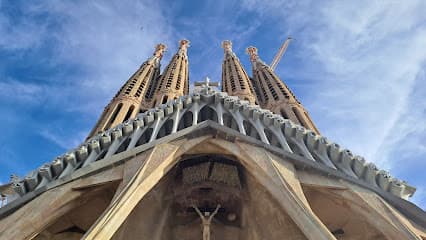
You stand on Carrer de la Marina, neck craned back until your vertebrae protest, staring at something that shouldn’t exist. This is the Façana del Naixement—the Nativity Facade—and it is the beating, frantic heart of the Sagrada Família. While the rest of this eternal construction project often feels like a high-tech, computer-optimized marvel, this section is different. This is the part Antoni Gaudí actually touched. It’s the only part of the basilica he saw nearing completion before a tram ended his life in 1926, and you can feel his fingerprints all over the madness.
Forget the clean lines of modern architecture. This is a riot. It looks like the earth decided to vomit up a Bible story and then froze it in mid-air. The stone doesn't just sit there; it drips, it flows, it crawls. It’s been described as looking like melting wax or a coral reef that’s been dragged out of the Mediterranean and left to dry in the Eixample sun. There are three portals here—Hope, Charity, and Faith—and every square inch is packed with a level of detail that borders on the pathological.
Look closer at the figures. These aren't idealized, ethereal saints. Gaudí, ever the obsessive, used real people as models. He took plaster casts of the local workers, the neighborhood poor, and even the dying in the nearby hospital to ensure the faces of his statues had the weight of actual human suffering and joy. The soldiers in the Massacre of the Innocents have six toes because the model he used had six toes. That’s the kind of beautiful, gritty reality that makes this place more than just a tourist trap. It’s a testament to the people of Barcelona as much as it is to the divine.
At the base, supporting the weight of this stone fever dream, are two turtles—one of the land and one of the sea. They represent the permanence of nature, while the chameleons on the sides remind you that everything changes. Above it all, the Tree of Life—a massive green cypress—is swarmed by white marble pigeons, symbolizing the faithful returning to God. It’s a chaotic, organic mess of symbolism that somehow works because it refuses to be polite.
If you’re wondering if the Nativity Facade is worth it compared to the newer Passion Facade on the other side, the answer is a resounding yes. The Passion Facade is cold, angular, and skeletal—a representation of death. But the Nativity is a celebration of life, messy and overflowing. It’s a lifetime of obsession distilled into a single wall of stone.
To get the most out of it, you need to be here when the sun is rising. The morning light hits these stones and turns the grey rock into something warm and golden, highlighting the textures that the afternoon shadows hide. Yes, you’ll be surrounded by thousands of people with selfie sticks. Yes, the noise of the city is relentless. But for a moment, if you focus on a single carved leaf or the expression on a stone shepherd’s face, the rest of the world falls away. You’re looking at the work of a man who knew he’d never see the finished product, yet he poured every ounce of his sanity into it anyway. That’s a rare kind of intensity you don't find in many other Gaudí buildings in Barcelona. It’s raw, it’s honest, and it’s completely insane.
Type
Tourist attraction
Duration
1-2 hours
Best Time
Morning (8:30 AM - 10:00 AM) for the best light on the facade and fewer crowds.
Guided Tours
Available
Audio Guide
Available
What People Say
gaudi(9)monuments(5)architectural(4)nativity of jesus(3)basilica(3)tickets(3)symbolism(3)passion of jesus(2)
Features
Tourist attraction
Categories
ArchitectureUNESCOGaudíReligious Site
Ticket Prices
adult€26.00
child€0.00
senior€21.00
Must-See Highlights
The Tree of Life (cypress tree with white doves)
The two turtles at the base of the columns
The Portal of Charity (the central entrance)
The intricate carvings of the Massacre of the Innocents
Visitor Tips
Book tickets at least 2-3 weeks in advance as they sell out daily.
The Nativity towers offer a better view of the sea and the old city compared to the Passion towers.
Bring binoculars to see the high-level details of the sculptures and the 'melting' stone effects.
Good For
Architecture enthusiastsHistory buffsPhotographersFirst-time visitors
Why Visit
The only facade constructed under Antoni Gaudí's direct personal supervision
Intricate 'melting stone' style featuring real-life plaster casts of 19th-century locals
Part of the UNESCO World Heritage site 'Works of Antoni Gaudí'
Nearby Landmarks
- 1-minute walk from Plaça de Gaudí
- 10-minute walk from Hospital de Sant Pau Recinte Modernista
- 15-minute walk from Casa Milà (La Pedrera)
Accessibility
- Wheelchair accessible at ground level
- Towers are not accessible for those with reduced mobility
- Visual aids available
Location
Carrer de la Marina, 253
Eixample, Barcelona
Nearby Hotels
Nearby Restaurants
In Eixample
ATTRACTION
Mural Margalef
Eixample
A towering splash of Mediterranean blue breaking the rigid geometry of Eixample, Joan Margalef’s mural is a visceral reminder that Barcelona’s soul isn't just in its museums.
0.0(0)
Tourist attraction
ATTRACTION
Mural Margalef
Eixample
A geometric middle finger to urban decay, this massive kinetic mural by Eduard Margalef turns a drab Eixample blind wall into a rhythmic, shifting explosion of optical art.
0.0(0)
Tourist attraction
ATTRACTION
Happy Foodies
Eixample
Forget the plastic-wrapped tourist traps; this is a deep dive into the grease, garlic, and soul of Catalan cooking where you actually learn to handle a knife and a porrón.
0.0(0)
Sightseeing tour agencyTour agency
Frequently Asked Questions
Is the Nativity Facade worth visiting?
Absolutely. It is the only facade built almost entirely during Gaudí's lifetime and contains the most intricate, hand-carved details of the entire basilica.
What is the difference between the Nativity and Passion facades?
The Nativity Facade (East) celebrates the birth of Jesus with organic, ornate carvings by Gaudí. The Passion Facade (West) represents the crucifixion with stark, angular, and minimalist sculptures by Josep Maria Subirachs.
Can you go up the towers on the Nativity Facade?
Yes, if you purchase a ticket that includes tower access, you can take an elevator up the Nativity towers for views over the eastern part of Barcelona and a close-up look at the facade's pinnacles.
What is the best time to see the Nativity Facade?
The best time is early morning. Because it faces east, the rising sun illuminates the intricate carvings and creates a golden glow on the stone.
Reviews
0 reviews for Façana del Naixement
No reviews yet. Be the first to share your experience!