4.3
33 verified reviews
About
The Eixample is a beautiful, relentless machine. It is a grid of stone, sun-baked octagons, and the constant, low-frequency hum of a city that never quite figures out how to shut up. But Barcelona has secrets, and most of them are hidden behind the heavy, unassuming doors of its apartment blocks. Espai Nur is one of those secrets—a 'jardí d'interior d'illa' that feels less like a municipal project and more like a hard-won victory for the neighborhood.
To understand this place, you have to understand the Eixample. When Ildefons Cerdà designed this neighborhood in the 19th century, he envisioned vast green lungs in the center of every block. Then greed happened. Developers filled those lungs with concrete, workshops, and more apartments, suffocating the original dream. Espai Nur is the city clawing that space back, one courtyard at a time. Located on Carrer del Consell de Cent—a street recently transformed into a 'Superilla' or Superblock—the approach itself is a trip. You’re walking through a pedestrianized experiment, past oversized planters and people rediscovering the lost art of strolling without the fear of being flattened by a SEAT Ibiza.
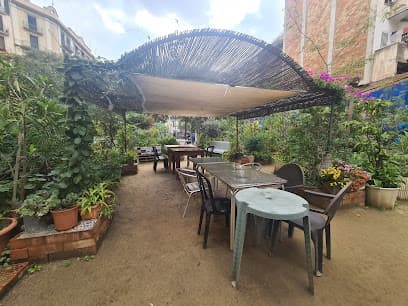
When you step into Espai Nur, the volume drops. The roar of the city is replaced by the rustle of leaves and the occasional clatter of a coffee cup. It’s not a 'park' in the way an American or a Londoner thinks of one. There are no sprawling lawns or grand fountains. Instead, you get a protein hit of urban nature: gritty, honest, and deeply necessary. It’s a space defined by its boundaries—the high walls of the surrounding buildings, the laundry hanging from balconies, the life of the city looking down on you.
Then there’s the human element. Reviews often mention 'la señora,' the unofficial or official gatekeeper of the vibe. This is what gives the space its character. It’s not a sterile, managed environment; it’s a community living room. You’ll see old men who look like they’ve been sitting at the same table since the Transition, arguing over football with a passion that suggests the world depends on the outcome. You’ll see young parents trying to keep their sanity while their kids explore the small patches of green. It’s a place where the 'nature' is secondary to the human connection. The tables here aren't for influencers to pose with avocado toast; they are for actual conversations, for reading a dog-eared book, or for simply staring at the sky and remembering that you are more than just a line on a spreadsheet.
The air here smells different. It’s a mix of damp earth, jasmine if you catch it in the right season, and the faint, lingering scent of someone’s lunch wafting down from a third-floor kitchen. It’s visceral. It’s real. It’s the kind of place that reminds you why people live in cities in the first place—not for the monuments, but for the moments of shared silence in between them.
Is it worth visiting? If you’re looking for a checklist attraction to post on your feed, probably not. You’ll be bored in five minutes. But if you’ve been walking the hot pavement of the Eixample for three hours and your soul feels like it’s been through a paper shredder, Espai Nur is the medicine you need. It’s a reminder that even in a city as crowded and famous as Barcelona, there are still places that belong to the people who actually live here. It’s a quiet success of urban planning and community persistence. Go there, sit down, shut up, and just breathe. The rest of the city can wait.
Type
Park
Duration
30-60 minutes
Best Time
Late afternoon for the best light and local atmosphere.
What People Say
nature(4)table(2)la señora(2)
Features
Park
Categories
Urban GardenCommunity SpaceArchitecture
Ticket Prices
Free Admission
No tickets required
Opening Hours
- Monday10:01 AM to 8 PM
- Tuesday10:01 AM to 8 PM
- Wednesday10:01 AM to 8 PM
- Thursday10:01 AM to 8 PM
- Friday10:01 AM to 8 PM
- Saturday10:01 AM to 8 PM
- Sunday10:01 AM to 8 PM
Must-See Highlights
The 'Superilla' pedestrian street approach
The community tables where locals gather
The unique perspective of looking up at Eixample apartment balconies
Visitor Tips
Bring a book and a bottle of water; there are no cafes inside the garden itself.
Respect the silence; this is a residential area where sound echoes off the walls.
Look for the entrance—it can look like a standard doorway or a small passage between buildings.
Good For
Solo travelersBudget travelersLocal life seekersFamilies with small children
Why Visit
Authentic 'Interior d'Illa' experience inside a residential block
Located on the newly pedestrianized Consell de Cent Superilla
A genuine community atmosphere far from the tourist crowds
Nearby Landmarks
- Parc de Joan Miró (10-minute walk)
- Plaça d'Espanya (15-minute walk)
- Las Arenas Shopping Centre (12-minute walk)
- Mercat del Ninot (12-minute walk)
Accessibility
- Flat terrain
- Street level access
- Benches available
Location
Carrer del Consell de Cent, 129
Eixample, Barcelona
Nearby Hotels
Nearby Restaurants
In Eixample
ATTRACTION
Mural Margalef
Eixample
A towering splash of Mediterranean blue breaking the rigid geometry of Eixample, Joan Margalef’s mural is a visceral reminder that Barcelona’s soul isn't just in its museums.
0.0(0)
Tourist attraction
ATTRACTION
Mural Margalef
Eixample
A geometric middle finger to urban decay, this massive kinetic mural by Eduard Margalef turns a drab Eixample blind wall into a rhythmic, shifting explosion of optical art.
0.0(0)
Tourist attraction
ATTRACTION
Happy Foodies
Eixample
Forget the plastic-wrapped tourist traps; this is a deep dive into the grease, garlic, and soul of Catalan cooking where you actually learn to handle a knife and a porrón.
0.0(0)
Sightseeing tour agencyTour agency
Frequently Asked Questions
Is Espai Nur worth visiting?
Only if you want a quiet, local escape from the city noise. It is a small community garden, not a major tourist attraction with monuments or facilities.
What is the best time to visit Espai Nur?
Late afternoon is best when the sun hits the courtyard at an angle and the local neighborhood life is at its peak, but before it gets too crowded with families after school.
How do I get to Espai Nur?
It is located at Carrer del Consell de Cent, 129. The nearest Metro stations are Rocafort (L1) and Urgell (L1), both about a 5-minute walk away.
Is there an entrance fee for Espai Nur?
No, it is a public space and free to enter, though it may have specific opening hours typical of Barcelona's interior gardens (usually 10:00 to sunset).
Reviews
0 reviews for Espai Nur
No reviews yet. Be the first to share your experience!