4.5
13 verified reviews
About
Barcelona’s Eixample is a masterpiece of urban planning or a claustrophobic grid of internal combustion, depending on how much diesel you’ve inhaled that day. Ildefons Cerdà, the man who designed this sprawling chessboard in the 19th century, wasn’t a sadist. He was a visionary. He imagined wide streets and, more importantly, lush green lungs inside every single block. He wanted the working class to have air, light, and a place to breathe. Then the developers moved in, greed took the wheel, and those promised gardens were choked out by concrete, warehouses, and parking garages. For a century, the 'interior d’illa'—the heart of the block—was a lost world.
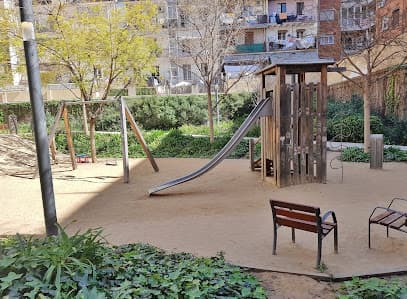
But the city is clawing it back, one block at a time. The Espai interior d'Illa at Carrer de Còrsega, 199—officially known as the Jardins d'Elena Maseras—is one of these small, hard-won victories. You don’t just stumble upon it. You have to look for the unassuming passage, a literal hole in the wall of the Eixample’s relentless facade. You walk through a corridor that feels like you’re trespassing on someone’s private life, and suddenly, the roar of the motorcycles on Còrsega vanishes. It’s replaced by the rhythmic 'thwack' of a tennis ball or the high-pitched negotiations of kids on a playground.
This isn't a 'must-see' in the sense that it has gold-leafed altars or Gaudí’s hallucinogenic curves. It’s a park for the people who actually live here. The 'apple' (or 'poma' in Catalan, which confusingly means both fruit and city block) has been hollowed out to create a sanctuary. You’ll see the 'bancs'—the benches—occupied by grandmothers who have lived in these flats since the transition to democracy, watching over toddlers with the hawk-like intensity only a Mediterranean matriarch can muster. Above you, the real Barcelona is on display: laundry drying in the sun, the hum of air conditioners, the occasional clink of a coffee cup from a balcony.
The space is named after Elena Maseras, the first woman in Spain to enroll in university, a medical student who had to fight every step of the way just to sit in a classroom. There’s a quiet dignity in that. The garden itself is functional—paved areas, some hardy Mediterranean flora, and the kind of shade that feels like a mercy in July. It’s a place to sit with a book, a cheap beer from the corner 'supermercat,' and realize that the best parts of a city aren't always the ones they charge you twenty euros to enter.
Is it worth it? If you’re looking for a postcard, no. If you’re looking for the soul of the Eixample—the part that refuses to be just a backdrop for tourists—then yes. It’s a reminder that even in a city as crowded as Barcelona, there are still secrets hidden in plain sight, tucked away behind the heavy wooden doors and the exhaust fumes. It’s a small, paved apology for a century of bad planning, and it’s beautiful in its own mundane, essential way. Come here when the sun is hitting the top of the buildings and the shadows are long. Sit on a bench. Listen to the silence. This is what a neighborhood feels like when it’s allowed to breathe.
Type
Park
Duration
30-45 minutes
Best Time
Late afternoon when the neighborhood comes alive with families and the heat of the day has faded.
What People Say
apple(2)bank(2)
Features
Park
Categories
GardenUrban PlanningLocal Life
Ticket Prices
Free Admission
No tickets required
Opening Hours
- Monday10 AM to 8 PM
- Tuesday10 AM to 8 PM
- Wednesday10 AM to 8 PM
- Thursday10 AM to 8 PM
- Friday10 AM to 8 PM
- Saturday10 AM to 8 PM
- Sunday10 AM to 8 PM
Must-See Highlights
The quiet passage leading from the street
The view of the surrounding Eixample balconies and laundry lines
The commemorative plaque for Elena Maseras
Visitor Tips
Bring a book or a snack; there are no cafes inside the courtyard itself.
Respect the neighbors—sound echoes in these enclosed courtyards.
Check the closing times at the gate, as these parks are locked at night.
Good For
Families with childrenSolo travelers seeking quietArchitecture and urban planning enthusiasts
Why Visit
Authentic local atmosphere away from the tourist crowds
A rare example of Ildefons Cerdà's original 19th-century urban vision
Peaceful sanctuary with a playground and benches in the heart of the city
Nearby Landmarks
- Hospital Clínic (5-minute walk)
- Mercat del Ninot (7-minute walk)
- Avinguda Diagonal (8-minute walk)
- Plaça de Francesc Macià (12-minute walk)
Accessibility
- Flat paved entrance
- Wheelchair accessible paths
- Accessible seating
Location
Carrer de Còrsega, 199
Eixample, Barcelona
Nearby Hotels
Nearby Restaurants
In Eixample
ATTRACTION
Mural Margalef
Eixample
A towering splash of Mediterranean blue breaking the rigid geometry of Eixample, Joan Margalef’s mural is a visceral reminder that Barcelona’s soul isn't just in its museums.
0.0(0)
Tourist attraction
ATTRACTION
Mural Margalef
Eixample
A geometric middle finger to urban decay, this massive kinetic mural by Eduard Margalef turns a drab Eixample blind wall into a rhythmic, shifting explosion of optical art.
0.0(0)
Tourist attraction
ATTRACTION
Happy Foodies
Eixample
Forget the plastic-wrapped tourist traps; this is a deep dive into the grease, garlic, and soul of Catalan cooking where you actually learn to handle a knife and a porrón.
0.0(0)
Sightseeing tour agencyTour agency
Frequently Asked Questions
Is Espai interior d'Illa worth visiting?
It is worth it if you want to escape the noise of the Eixample and see how locals actually live. It's a quiet, functional neighborhood park, not a major tourist landmark.
What is the history of the Jardins d'Elena Maseras?
Named after the first Spanish woman to attend university, this space is part of a city initiative to reclaim the interior courtyards of Eixample blocks as public green spaces, as originally intended by urban planner Ildefons Cerdà.
How do I find the entrance to the garden?
The entrance is located at Carrer de Còrsega, 199. Look for a public passage or 'passatge' that leads through the building into the center of the block.
Is there an entrance fee for the park?
No, admission is completely free as it is a public municipal park maintained by the Barcelona City Council.
Reviews
0 reviews for Espai interior d'Illa
No reviews yet. Be the first to share your experience!