4.7
14 verified reviews
About
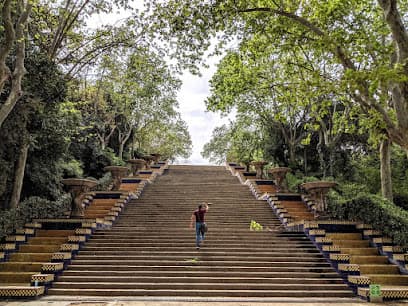
Barcelona is a city built on layers of ambition, and nowhere is that more obvious than the climb up Montjuïc. The Escales amb fonts—the stairs with fountains—are a relic of the 1929 International Exposition, a time when the city wanted to prove it could out-grand the rest of Europe. It’s a massive, stone-hewn statement of intent that connects the lower sprawl of Plaça d'Espanya to the looming, neo-Baroque authority of the Palau Nacional.
Most people, the ones with sensible shoes and a lack of poetic masochism, take the escalators. They glide up, staring at their phones, missing the point entirely. To really feel this place, you need to take the stairs. You need to feel the heat radiating off the stone and hear the rhythmic, heavy hiss of the water cascading down the tiers. It’s a sensory overload of 1920s engineering. Carles Buïgas, the man who dreamed up the Magic Fountain, didn’t just want to move water; he wanted to choreograph it. Even when the fountains are dry—which, let’s be honest, happens more often lately due to the drought restrictions—the architecture remains a gut-punch of scale.
As you ascend, the city begins to reveal itself in slices. First, it’s just the tops of the Venetian Towers. Then, the red-brick bullring-turned-mall. By the time you reach the mid-point, the entire grid of the Eixample is laid out like a map of every mistake and triumph the city has ever made. It’s one of the best views in Barcelona, and it doesn’t cost you a single Euro. You’re standing on the spine of the mountain, surrounded by the ghosts of 1929, watching the 21st-century traffic crawl below.
The atmosphere here is a strange cocktail of high art and low-stakes tourism. You’ve got the MNAC (Museu Nacional d'Art de Catalunya) sitting at the top like a crown, housing some of the most haunting Romanesque frescoes in the world. At the bottom, you’ve got the tour buses and the selfie sticks. But on the stairs themselves, there’s a weird kind of peace. You’ll see locals using the steps for brutal morning workouts, their lungs burning in the Mediterranean air, and couples sitting on the stone ledges, sharing a cheap bottle of wine as the sun starts to dip behind the Tibidabo hills.
Is Escales amb fonts worth it? If you’re looking for a polished, hermetically sealed tourist experience, maybe not. The stone is worn, the water can be temperamental, and the climb will make you regret that third plate of patatas bravas from lunch. But if you want to understand the scale of Barcelona’s ego, and if you want a view that makes you feel both very small and very alive, this is where you go. It’s a transition zone—a place between the noise of the city and the quiet of the mountain museums.
Don't come here at noon when the sun is trying to cook you alive. Come at sunset. Watch the light turn the stone to gold and the sky to a bruised purple. This is when the city looks its best, and when the ambition of 1929 feels less like a historical footnote and more like a living, breathing part of the landscape. It’s honest, it’s grand, and it’s exactly what Barcelona should be.
Type
Tourist attraction
Duration
30-45 minutes
Best Time
Sunset for the best lighting and cooler temperatures.
Features
Tourist attraction
Categories
ArchitectureFountainsPublic SpacePhotography
Ticket Prices
Free Admission
No tickets required
Must-See Highlights
The view from the top landing looking toward Plaça d'Espanya
The intricate stone carvings on the fountain tiers
The transition from the Magic Fountain to the Palau Nacional
Visitor Tips
Check local news for drought restrictions as the fountains may be turned off to save water.
Use the escalators to go up and the stairs to go down to save your knees while still enjoying the architecture.
Combine this with a visit to the MNAC rooftop for an even higher vantage point.
Good For
Budget travelersPhotography enthusiastsArchitecture buffsCouples
Why Visit
Buïgas Water Engineering
1929 International Exposition Grandeur
Unobstructed City Axis Views
Nearby Landmarks
- Museu Nacional d'Art de Catalunya (MNAC) - 1-minute walk
- The Magic Fountain (Font Màgica) - 3-minute walk
- Mies van der Rohe Pavilion - 7-minute walk
- Poble Espanyol - 10-minute walk
Accessibility
- Outdoor escalators available
- Paved pathways
- Wheelchair accessible via side ramps and elevators in the nearby MNAC
Location
Parc, Carrer del Mirador del Palau Nacional, 2
Sants-Montjuïc, Barcelona
Nearby Hotels
Nearby Restaurants
In Sants-Montjuïc
ATTRACTION
Bolets1
Sants-Montjuïc
A gritty, earthy temple to the Catalan obsession with wild mushrooms, where the dirt is real, the fungi are seasonal gold, and the air smells like the damp floor of a Pyrenean forest.
0.0(0)
Tourist attraction
ATTRACTION
Montjuic aparca
Sants-Montjuïc
The unglamorous base camp for your Montjuïc assault. A tactical slab of asphalt where the city's chaos fades into the pine-scented ghosts of the 1992 Olympics.
0.0(0)
Tourist attraction
ATTRACTION
Паркінг Барселона
Sants-Montjuïc
A sprawling slab of industrial reality in the Zona Franca. No Gaudí here—just hot asphalt, diesel fumes, and the honest utility of a secure place to park your rig.
0.0(0)
Park
Frequently Asked Questions
Is Escales amb fonts worth visiting?
Absolutely. It offers a sweeping perspective of Barcelona's skyline for free, and the architectural scale of the cascades is a study in early 20th-century urban design.
How do I get to Escales amb fonts?
Take the Metro (L1 or L3) to Plaça d'Espanya. From there, walk toward the Venetian Towers and follow the pedestrian axis toward the MNAC palace; the stairs and fountains are directly in front of the museum.
Are there escalators at Escales amb fonts?
Yes, there are outdoor escalators running alongside the main staircases for those who want the view without the physical exertion.
What is the best time to visit?
Sunset is the prime time. The light hits the Palau Nacional and the city below perfectly, and the temperature is much more manageable than during the midday heat.
Reviews
0 reviews for escales amb fonts
No reviews yet. Be the first to share your experience!