4.3
12 verified reviews
About
History is a cruel mistress, and in Barcelona, she usually has a crush on Antoni Gaudí. But if you want to understand the soul of the city’s curves—the actual sweat and grit behind the trencadís mosaics and the wrought iron that looks like it’s screaming—you need to look at Josep Maria Jujol. For years, he was the 'collaborator,' the guy in the shadow, the one who made Gaudí’s visions actually pop. But here, at the corner of Carrer de Sicília and Avinguda Diagonal, Jujol finally takes the mic for a solo.
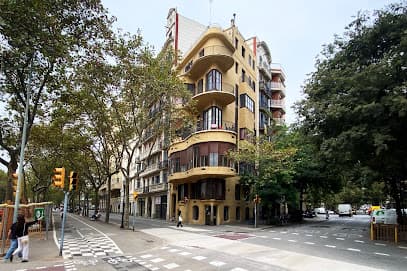
Casa Planells, or the Edifici Modernista Jujol, is a middle finger to the rigid geometry of the Eixample district. While the rest of the neighborhood was playing by the rules of Ildefons Cerdà’s grid, Jujol was handed a plot of land so small and awkwardly shaped it would make a modern developer weep. We’re talking about a tiny, triangular sliver of earth. Most architects would have built a boring box and called it a day. Jujol? He built something that defies the physics of the plot.
Standing on the sidewalk, you see the building doesn’t just sit there; it flows. It’s one of the best Modernista buildings in Barcelona precisely because it’s so restrained yet so radical. Built in 1924, it’s the last gasp of the movement, leaning into something almost Art Deco or Expressionist. The balconies don’t just hang; they undulate like waves hitting the shore of the Diagonal. The wrought iron is delicate, almost fragile-looking, a stark contrast to the heavy stone of the surrounding blocks. It’s a concentrated hit of design, a reminder that architecture isn't about how much marble you can buy, but how you manipulate the air.
Inside—if you’re lucky enough to catch it during a rare open house or if you know someone with an office there—the magic continues. Jujol used a series of mezzanines and winding staircases to trick the eye into thinking the 120-square-meter floor plan is a palace. It’s a masterclass in urban density. He used materials that were cheap at the time—plaster, wood, iron—and turned them into something that feels expensive because of the thought behind it.
Let’s be honest: this isn't the Sagrada Família. There are no queues, no audio guides narrated by B-list celebrities, and no gift shops selling overpriced magnets. It’s a private building. Most of the time, you’re just standing on a busy street corner with cars buzzing past, looking up at a facade. To the casual tourist, it’s just another old building. To the person who actually gives a damn about how cities are built, it’s a pilgrimage site.
Is it worth the trek? If you’re the type of person who checks boxes off a 'Top 10' list, probably not. You’ll be bored in five minutes. But if you want to see what happens when a genius is backed into a corner—literally—and forced to innovate his way out, Casa Planells is essential. It’s raw, it’s clever, and it’s a testament to the guy who did the heavy lifting while Gaudí got the statues. It’s a quiet, beautiful rebellion in stone and iron, standing right in the middle of the Eixample traffic.
Type
Tourist attraction
Duration
15-30 minutes
Best Time
Late afternoon for the best light on the facade's curves.
Features
Tourist attraction
Categories
ArchitectureModernismeJosep Maria Jujol
Ticket Prices
Free Admission
No tickets required
Must-See Highlights
The undulating balconies on the corner
The intricate wrought iron work
The fluid, 'melting' appearance of the stone facade
The mezzanine window arrangements
Visitor Tips
Bring a wide-angle lens if you're a photographer; the street corner is tight.
Combine this with a walk down Passeig de Sant Joan for a less touristy Eixample experience.
Look up at the ceilings of the balconies to see Jujol's subtle decorative touches.
Good For
Architecture loversPhotography enthusiastsSolo travelersBudget travelers
Why Visit
The last major work of the Modernista period in Barcelona
Incredible use of a tiny, 120-square-meter triangular plot
Designed by Josep Maria Jujol, Gaudí's most important collaborator
Nearby Landmarks
- Sagrada Família (8-minute walk)
- Casa Macaya (5-minute walk)
- Passeig de Sant Joan (3-minute walk)
- Palau del Baró de Quadras (12-minute walk)
Accessibility
- Viewable from public sidewalk
- Flat terrain around the building
Location
C/ de Sicília, 266
Eixample, Barcelona
Nearby Hotels
Nearby Restaurants
In Eixample
ATTRACTION
Mural Margalef
Eixample
A towering splash of Mediterranean blue breaking the rigid geometry of Eixample, Joan Margalef’s mural is a visceral reminder that Barcelona’s soul isn't just in its museums.
0.0(0)
Tourist attraction
ATTRACTION
Mural Margalef
Eixample
A geometric middle finger to urban decay, this massive kinetic mural by Eduard Margalef turns a drab Eixample blind wall into a rhythmic, shifting explosion of optical art.
0.0(0)
Tourist attraction
ATTRACTION
Happy Foodies
Eixample
Forget the plastic-wrapped tourist traps; this is a deep dive into the grease, garlic, and soul of Catalan cooking where you actually learn to handle a knife and a porrón.
0.0(0)
Sightseeing tour agencyTour agency
Frequently Asked Questions
Is Edifici Modernista Jujol (Casa Planells) worth visiting?
Yes, if you are an architecture enthusiast. While you mostly view it from the outside, it is a masterclass in how to build on a tiny, irregular urban plot.
Can you go inside Casa Planells?
Generally, no. It is a private building used for offices and residences. It occasionally opens for events like the 48h Open House Barcelona in October.
How do I get to Casa Planells?
It is located at the corner of Carrer de Sicília and Avinguda Diagonal. The nearest Metro stations are Sagrada Família (L2/L5) and Verdaguer (L4/L5), both about a 5-10 minute walk away.
Reviews
0 reviews for Edifici Modernista JUJOL
No reviews yet. Be the first to share your experience!