About
If you’ve spent any time in the center of Barcelona lately, you know the feeling. It’s a beautiful, sun-drenched claustrophobia. The Gothic Quarter is a labyrinth of selfie sticks, and the Eixample is a grid of high-end retail and exhaust fumes. To find the soul of the city—the quiet, unhurried part that doesn’t care if you’re there or not—you have to head uphill. You go to Sarrià, where the air gets a little thinner and the bank accounts get a lot thicker. Specifically, you go to the Jardins de Can Sentmenat to see a tree. Not just any tree, but the Ceratonia siliqua, a monumental carob that has seen more history than most of the buildings in this neighborhood.
This isn't a 'tourist attraction' in the way the city's marketing board likes to package them. There are no turnstiles here. No one is trying to sell you a overpriced magnet or a lukewarm croquette. The Ceratonia siliqua is a cataloged tree of local interest, a gnarled, twisted survivor that looks like it was designed by a particularly moody set decorator for a dark fairy tale. Its trunk is a riot of knots and scars, a testament to decades of Mediterranean sun and the slow, patient crawl of time. It sits in the shadow of the Palau de Can Sentmenat, a 19th-century pile that now houses a design school, EINA.
Walking into these gardens feels like stepping into a different century. The layout is a mix of French formal precision and the kind of romantic, slightly overgrown wildness that only comes with age. You’ll see students from the design school sitting on the grass, sketching the shadows, or old Sarrià money walking their well-groomed dogs. The carob tree itself—the Ceratonia siliqua—is the anchor of the space. In the late summer and autumn, the ground is littered with carob pods. They have that distinct, earthy, slightly fermented smell—a scent that, for many locals, is the smell of the old countryside that used to exist before the city swallowed the hills.
Is it worth the trek? That depends on what you’re looking for. If you need a checklist of 'must-see' monuments to justify your flight, you’ll be disappointed. It’s a tree in a garden. But if you want to understand the texture of Barcelona beyond the Gaudí-fied postcards, this is where you find it. It’s about the silence, broken only by the distant hum of the city below and the occasional shout from a nearby schoolyard. It’s about the way the light filters through the leaves of a tree that was here long before the tourists arrived and will likely be here long after we’ve all moved on to the next trendy destination.
The gardens are free, which is a rarity in a city that’s increasingly monetizing every square inch of shade. You can sit on a stone bench, look at the twisted limbs of the carob, and realize that the best things in Barcelona—the things that actually matter—don't require a reservation or a QR code. They just require you to show up, shut up, and pay attention. It’s a quiet, dignified corner of a neighborhood that prides itself on dignity. It’s honest. It’s real. And in a city that can sometimes feel like a theme park, that’s worth more than any skip-the-line ticket.
Type
Garden
Duration
45-60 minutes
Best Time
Late afternoon for the best light through the trees and a cooler temperature during the uphill walk.
Features
Garden
Categories
NatureBotanyHistoryGardens
Ticket Prices
Free Admission
No tickets required
Must-See Highlights
The monumental Ceratonia siliqua (Carob tree)
The statues representing the different lineages of the Sentmenat family
The view of the Palau de Can Sentmenat facade
Visitor Tips
Bring a book; this is one of the best places in the city for quiet reading.
The gardens are right next to a design school, so the small cafe nearby often has a young, creative vibe.
Combine this with a visit to the Monestir de Pedralbes for a perfect 'Old Sarrià' afternoon.
Good For
Nature loversCouplesSolo travelersPhotography enthusiasts
Why Visit
Cataloged 'Tree of Local Interest' with ancient, gnarled architecture
Located in the romantic 19th-century gardens of a former aristocratic palace
One of the quietest, most authentic local escapes in the Sarrià district
Nearby Landmarks
- Monestir de Pedralbes (12-minute walk)
- Parc de l'Oreneta (10-minute walk)
- Reina Elisenda FGC Station (8-minute walk)
Accessibility
- Main paths are gravel but relatively flat
- Accessible from the street level entrance
Location
Av. de Josep Vicenç Foix, 102
Sarrià-Sant Gervasi, Barcelona
Nearby Hotels
Nearby Restaurants
In Sarrià-Sant Gervasi
ATTRACTION
Casa Narcís Bosch
Sarrià-Sant Gervasi
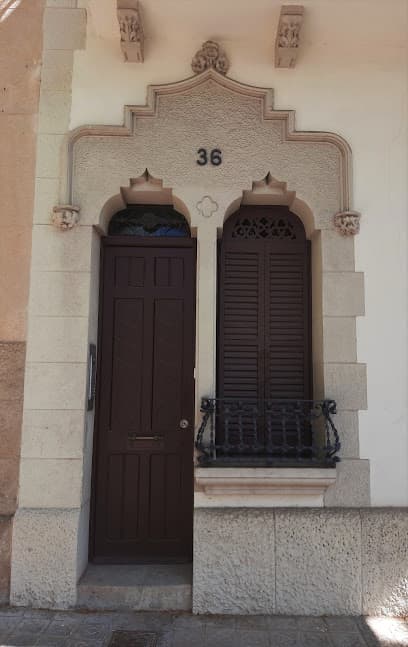
A Modernista fever dream tucked away in Sarrià, where Salvador Valeri i Pupurull’s stone curves and ironwork prove that Gaudí wasn't the only genius in town.
0.0(0)
Tourist attraction
ATTRACTION
Plaça de Calvó
Sarrià-Sant Gervasi
A quiet, unpretentious slice of Sant Gervasi where the only drama is a toddler losing a shoe. No Gaudí, no crowds, just trees, benches, and the sound of real life in the Zona Alta.
0.0(0)
Park
ATTRACTION
Pipican Piscines i Esports
Sarrià-Sant Gervasi
A dirt-caked arena of canine chaos set against the polished backdrop of Sarrià-Sant Gervasi, where the neighborhood’s elite and their four-legged shadows come to settle scores.
0.0(0)
Park
Frequently Asked Questions
Is the Ceratonia siliqua worth visiting?
Yes, if you appreciate nature and quiet, romantic gardens. It is a monumental carob tree located in the peaceful Jardins de Can Sentmenat, offering a break from the city's tourist-heavy areas.
How do I get to the Jardins de Can Sentmenat?
Take the FGC (Ferrocarrils de la Generalitat) line S1 or S2 to the Reina Elisenda station. From there, it is a pleasant 10-minute walk uphill through the Sarrià neighborhood.
Is there an entrance fee for the gardens?
No, the Jardins de Can Sentmenat are public and free to enter. They are open daily from 10:00 AM until sunset.
What else is near the Ceratonia siliqua?
The gardens are adjacent to the EINA University School of Design and Art. The historic Monestir de Pedralbes is also just a 10-15 minute walk away.
Reviews
0 reviews for Ceratonia siliqua
No reviews yet. Be the first to share your experience!