4.3
3 verified reviews
About
Barcelona is a city built on the relentless, grid-like ambition of Ildefons Cerdà, but it was the architects like Jeroni Granell i Manresa who gave that grid its soul—and its attitude. Walking down Carrer de Mallorca, you aren’t looking for a museum with a gift shop and a velvet rope. You’re looking for the Cases Jeroni F. Granell, a pair of buildings at numbers 184 and 188 that serve as a visceral reminder that a century ago, the Catalan bourgeoisie didn't just build apartments; they built monuments to their own refined taste.
Jeroni Granell wasn't just some guy with a drafting table. He was a partner in Rigalt, Granell i Cia, the legendary stained-glass workshop that provided the translucent magic for the Palau de la Música Catalana. When he turned his attention to these residential facades around 1900, he didn't hold back. This isn't the hallucinogenic melting-wax aesthetic of Gaudí; it’s something more structured but no less intense. It’s about the skin of the building.
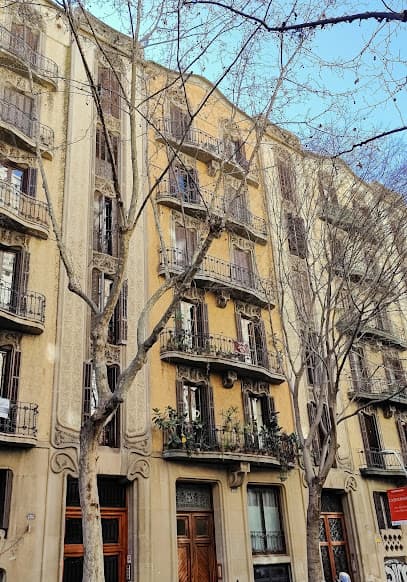
At Mallorca 184, the facade is covered in sgraffito—a technique where layers of plaster are scratched away to reveal contrasting colors underneath. Here, it’s a riot of floral motifs and organic curves that seem to grow right out of the stone. You stand on the sidewalk, dodging the local commuters and the occasional delivery scooter, and you look up at those wrought-iron balconies. They aren't just safety features; they are delicate, twisted metalwork that looks like it was frozen mid-bloom. The craftsmanship is staggering, the kind of detail that makes modern glass-and-steel boxes look like the cheap, soul-sucking filing cabinets they are.
The reality of visiting Cases Jeroni F. Granell is that you are a voyeur. These are private residences. People live here. They cook dinner, argue about the laundry, and sleep behind those ornate windows. You can’t go inside and poke around the hallways unless you know someone or have a very convincing lie ready for the intercom. But that’s the beauty of an Eixample architecture tour. The 'best' parts of the city aren't always behind a paywall. They are right there on the street, weathered by a hundred years of Mediterranean sun and city grit.
If you’re looking for the 'best Modernista buildings Barcelona' has to offer, you’ll eventually find yourself here, away from the suffocating crowds of Passeig de Gràcia. Mallorca 188 offers a slightly different flavor, but the DNA is the same—a commitment to the idea that even the most functional parts of a city should be beautiful. It’s a quiet excellence. There are no tour buses idling outside, no guys in mascot costumes trying to charge you five euros for a photo. It’s just you and the architecture.
Is it worth the walk? If you give a damn about how a city expresses itself, then yes. It’s a ten-minute stroll from the chaos of Enric Granados, a street lined with overpriced gin bars and decent tapas. You grab a coffee, walk over to Mallorca, and spend fifteen minutes staring at the sgraffito. You notice the way the light hits the stone, the way the shadows fall across the floral patterns, and you realize that this is the real Barcelona. It’s a city that refuses to be boring, even when it’s just standing still. It’s honest, it’s beautiful, and it doesn't care if you like it or not.
Type
Tourist attraction
Duration
15-30 minutes
Best Time
Morning for the best photographic light on the facade.
What People Say
building(2)
Features
Tourist attraction
Categories
ArchitectureModernismeHistory
Ticket Prices
Free Admission
No tickets required
Must-See Highlights
The intricate floral sgraffito on the facade of number 184
The ornate wrought-iron balcony railings
The decorative stone carvings around the main entrance doors
Visitor Tips
Bring a zoom lens to capture the high-level sgraffito details.
Combine this with a walk down Enric Granados for some of the city's best cafe culture.
Remember these are private homes; keep noise levels down and don't try to enter the lobby.
Good For
Architecture enthusiastsPhotographersBudget travelersSolo travelers
Why Visit
Masterful Sgraffito: Some of the most intricate and well-preserved floral plasterwork in the Eixample.
Stained-Glass Heritage: Designed by Jeroni Granell, the man responsible for the glass in the Palau de la Música Catalana.
Crowd-Free Modernisme: A chance to see world-class Catalan architecture without the crushing tourist lines of the 'Block of Discord'.
Nearby Landmarks
- 5-minute walk from Carrer d'Enric Granados
- 12-minute walk from Casa Batlló
- 10-minute walk from Hospital Clínic
- 15-minute walk from La Pedrera (Casa Milà)
Accessibility
- Viewable from public sidewalk
- Flat terrain
- Wheelchair accessible street
Location
Carrer de Mallorca, 184, 188
Eixample, Barcelona
Nearby Hotels
Nearby Restaurants
In Eixample
ATTRACTION
Mural Margalef
Eixample
A towering splash of Mediterranean blue breaking the rigid geometry of Eixample, Joan Margalef’s mural is a visceral reminder that Barcelona’s soul isn't just in its museums.
0.0(0)
Tourist attraction
ATTRACTION
Mural Margalef
Eixample
A geometric middle finger to urban decay, this massive kinetic mural by Eduard Margalef turns a drab Eixample blind wall into a rhythmic, shifting explosion of optical art.
0.0(0)
Tourist attraction
ATTRACTION
Happy Foodies
Eixample
Forget the plastic-wrapped tourist traps; this is a deep dive into the grease, garlic, and soul of Catalan cooking where you actually learn to handle a knife and a porrón.
0.0(0)
Sightseeing tour agencyTour agency
Frequently Asked Questions
Can you go inside Cases Jeroni F. Granell?
No, these are private residential buildings. You can only view the stunning Modernista facades and architectural details from the public sidewalk.
Is there an entrance fee for Cases Jeroni F. Granell?
There is no fee as the attraction is the exterior of the buildings. It is a free highlight for anyone doing a self-guided architecture walk through the Eixample.
What is the best time to visit?
Morning light is best for photographing the facades, as the sun hits the sgraffito and stonework directly, highlighting the intricate floral details.
How do I get to Cases Jeroni F. Granell?
The buildings are located on Carrer de Mallorca. The nearest Metro stations are Hospital Clínic (L5) or Passeig de Gràcia (L2, L3, L4), both about a 10-minute walk away.
Reviews
0 reviews for Cases Jeroni F. Granell
No reviews yet. Be the first to share your experience!