About
You’re standing at the base of a mountain that isn’t really a mountain, looking up at a palace that isn’t really a palace. This is Montjuic, a hill that has seen everything from executions to Olympic glory, and Cascada Nº3 is a vital piece of the theatrical machinery that makes this ascent one of the most imposing in Europe. Built for the 1929 International Exposition, these cascades were designed to scream one thing to the world: Barcelona has arrived. It was monumentalism at its most caffeinated, a sprawling urban project meant to transform a rugged hillside into a neo-Baroque playground of light and water.
Cascada Nº3 is one of the lateral water features that flank the grand staircase leading from the Magic Fountain up toward the Museu Nacional d’Art de Catalunya (MNAC). While the main Font Màgica gets all the glory—the music, the crowds, the tourists holding up iPhones like they’re witnessing a religious apparition—the cascades are the supporting actors that actually do the heavy lifting of the atmosphere. They provide the rhythm. When the water is flowing, it’s a constant, low-frequency hum that drowns out the city traffic behind you. It’s a series of limestone tiers, weathered by decades of Mediterranean sun and chlorinated water, creating a cooling microclimate that you’ll desperately appreciate if you’re making the trek in July.
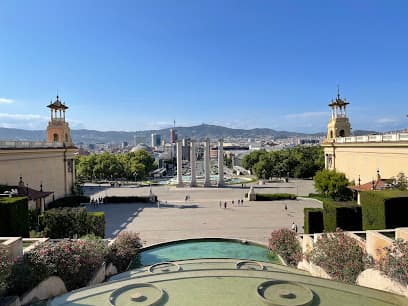
Carles Buïgas, the engineer and 'magician of light' behind the project, understood drama. He knew that a single fountain wasn't enough; you needed a progression. As you walk up the Avinguda de la Reina Maria Cristina, past the Venetian Towers that look like they were plucked straight from St. Mark’s Square, the cascades draw your eye upward. They frame the Palau Nacional, making the climb feel like a pilgrimage. It’s architectural manipulation of the highest order. The stone itself is heavy, solid, and unapologetically grand, a stark contrast to the sleek, minimalist Mies van der Rohe Pavilion tucked away just a few hundred yards to the west.
But let’s talk about the reality of 2025. Barcelona is a city grappling with its own thirst. Due to persistent drought conditions in Catalonia, the cascades and the Magic Fountain itself are often silenced to conserve water. When the pumps are off, Cascada Nº3 becomes a different kind of monument. It’s a silent, skeletal reminder of 20th-century excess. Even without the water, the geometry is worth a look. The way the shadows hit the basins at sunset, the weathered texture of the stone, the sheer scale of the ambition—it’s a ghost of a more optimistic era. It’s a place to sit on the stone wall, crack a cold beer you bought from a street vendor, and watch the light change over the Eixample district spread out below you.
Is it worth the walk? If you’re looking for a quick thrill, maybe not. But if you want to understand the DNA of Barcelona—a city that has always been obsessed with looking good for the neighbors and throwing a massive party—then Cascada Nº3 is essential. It’s a vital piece of the Montjuïc landscape because it represents the bridge between the old city and the modern metropolis. It’s a place for a quiet moment of reflection before you hit the museum or the Olympic stadium. It’s honest, it’s slightly faded, and it’s undeniably Barcelona. Don't expect a tropical rainforest; expect a masterclass in urban stagecraft that has aged with a certain stubborn grace.
Type
Tourist attraction
Duration
30-45 minutes
Best Time
Sunset, to watch the city lights come on and avoid the midday heat.
Features
Tourist attraction
Categories
ArchitectureHistoryPublic ArtParks
Ticket Prices
Free Admission
No tickets required
Must-See Highlights
The view looking back toward the Venetian Towers
The intricate stonework of the tiered basins
The nearby Four Columns (Les Quatre Columnes)
Visitor Tips
Check the drought status before you go if you're hoping to see running water.
Use the outdoor escalators if the climb feels too steep in the heat.
Combine this with a visit to the MNAC rooftop for a 360-degree view of the city.
Good For
Photography enthusiastsHistory buffsBudget travelersCouples
Why Visit
1929 International Exposition Architecture
Panoramic views of the Eixample district and Tibidabo
Masterpiece of hydraulic engineering by Carles Buïgas
Nearby Landmarks
- 3-minute walk from the Magic Fountain (Font Màgica)
- 5-minute walk from the Museu Nacional d’Art de Catalunya (MNAC)
- 7-minute walk from the Mies van der Rohe Pavilion
- 10-minute walk from Poble Espanyol
Accessibility
- Ramps are available for most levels
- Escalators serve the main climb up the avenue
Location
Sants-Montjuïc, Barcelona
Nearby Hotels
Nearby Restaurants
In Sants-Montjuïc
ATTRACTION
Bolets1
Sants-Montjuïc
A gritty, earthy temple to the Catalan obsession with wild mushrooms, where the dirt is real, the fungi are seasonal gold, and the air smells like the damp floor of a Pyrenean forest.
0.0(0)
Tourist attraction
ATTRACTION
Montjuic aparca
Sants-Montjuïc
The unglamorous base camp for your Montjuïc assault. A tactical slab of asphalt where the city's chaos fades into the pine-scented ghosts of the 1992 Olympics.
0.0(0)
Tourist attraction
ATTRACTION
Паркінг Барселона
Sants-Montjuïc
A sprawling slab of industrial reality in the Zona Franca. No Gaudí here—just hot asphalt, diesel fumes, and the honest utility of a secure place to park your rig.
0.0(0)
Park
Frequently Asked Questions
Is Cascada Nº3 worth visiting?
Yes, especially as part of the walk from Plaça d'Espanya to the MNAC. Even if the water is off due to drought, the architecture and the views of the city skyline are some of the best in Barcelona.
Is the water currently running at the Montjuic cascades?
Water usage is currently restricted due to drought conditions in Catalonia. It is common for the cascades to be dry or only operational during specific events. Check local news or the official Barcelona.cat website for real-time updates.
How do I get to Cascada Nº3?
Take the Metro (L1 or L3) to Espanya station. Walk between the two Venetian Towers and head up the Avinguda de la Reina Maria Cristina toward the National Museum; the cascades are located on the slopes leading up the hill.
Is there an entry fee for the cascades?
No, the cascades are part of the public park and monumental axis of Montjuic. They are free to view 24/7, though the area is best visited during daylight or when the evening lights are on.
Reviews
0 reviews for Cascada Nº3 - Fuentes de Montjuic
No reviews yet. Be the first to share your experience!