About
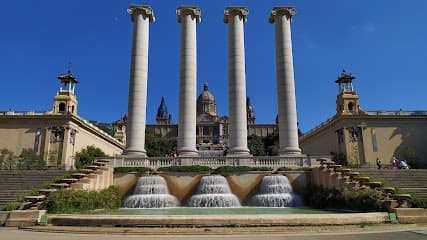
Walking up the monumental axis from Plaça d’Espanya toward the National Museum is a gauntlet of 1920s grandiosity. You pass the Venetian Towers—those brick sentinels that look like they’ve been plucked from St. Mark’s Square and dropped into the Catalan heat—and you start the climb. This isn't just a walk; it’s a choreographed ascent designed to make you feel small, a leftover flex from the 1929 International Exposition. Cascada Nº2 is a vital gear in that machine of spectacle. It’s the second tier of the 'Quatre Cascades,' the massive water feature designed by Carles Buïgas, the man who essentially decided that water and light were the only toys he needed to play god.
When the water is actually flowing, Cascada Nº2 is a sensory relief. It’s a rhythmic, crashing white noise that drowns out the tour buses and the frantic clicking of shutters. The design is pure Buïgas: a blend of classical symmetry and the kind of engineering that was revolutionary a century ago. It’s meant to be a transition, a cooling station on the way to the top of the hill. You feel the mist on your skin, a brief reprieve from the Mediterranean sun that beats down on the stone steps. It’s a protein rush for the eyes, a massive architectural statement that says, 'We can move mountains, or at least make them leak beautifully.'
But here is the honest truth, the part the glossy brochures tend to skip: Barcelona is a thirsty city. In recent years, the 'Emergència per sequera'—the drought emergency—has often silenced these stone basins. When the pumps are off, Cascada Nº2 changes character entirely. It becomes a sun-baked monument to Catalan ambition, a series of empty, dusty stone bowls that look like the ruins of a civilization that ran out of luck. There is a certain melancholy to it then, a quiet reminder that nature always gets the last word, no matter how much concrete you pour. Even dry, the scale of the thing is impressive, but it’s a different kind of beauty—one that’s more about the bones of the city than its skin.
If you’re doing the climb, don't just stare at your feet. Look back. From the level of Cascada Nº2, the view down Avinguda de la Reina Maria Cristina is one of the best in the city. You see the symmetry of the exhibition palaces, the distant sprawl of the Eixample, and the Tibidabo mountain looming in the background like a watchful parent. It’s the kind of view that makes the sweat and the inevitable calf-cramp worth it. You’ll see joggers punishing themselves on the stairs, locals sitting on the stone ledges with a cheap beer, and tourists looking confused about why the escalators are sometimes out of order. It’s a cross-section of the city in one of its most theatrical settings.
Is it worth the trek? Absolutely. Even if the water isn't crashing down the tiers, the Cascada Nº2 is a piece of history you can touch. It represents a moment when Barcelona wanted to show the world it was a modern, powerhouse city. It’s a place to pause, catch your breath, and realize that while the fountains might be temporary, the ambition that built them is permanent. Just bring water—the drinkable kind—because the hill doesn't care about your thirst, and the climb to the MNAC is longer than it looks from the bottom.
Type
Tourist attraction
Duration
30-45 minutes
Best Time
Sunset, to catch the golden light hitting the stone and the city lights flickering on below.
Features
Tourist attraction
Categories
ArchitectureFountainsHistoryPhotography
Ticket Prices
Free Admission
No tickets required
Must-See Highlights
The view looking back toward the Venetian Towers
The intricate stone carvings of the basins
The transition from the Magic Fountain to the MNAC palace
Visitor Tips
Check the drought status before you go if you specifically want to see water.
Use the escalators if the heat is brutal, but walk the stairs for the best photo angles.
Combine this with a visit to the MNAC rooftop for a 360-degree view.
Good For
Budget travelersArchitecture enthusiastsPhotographersFamilies
Why Visit
1929 World's Fair Heritage
Unrivaled views of the Venetian Towers and Tibidabo
Masterpiece of hydraulic engineer Carles Buïgas
Nearby Landmarks
- 3-minute walk to Museu Nacional d'Art de Catalunya (MNAC)
- 5-minute walk to Mies van der Rohe Pavilion
- 8-minute walk to Poble Espanyol
- 10-minute walk to Plaça d'Espanya
Accessibility
- Outdoor escalators available for the ascent
- Paved pathways
- Wheelchair accessible via side ramps and elevators in the nearby MNAC area
Location
Sants-Montjuïc, Barcelona
Nearby Hotels
Nearby Restaurants
In Sants-Montjuïc
ATTRACTION
Bolets1
Sants-Montjuïc
A gritty, earthy temple to the Catalan obsession with wild mushrooms, where the dirt is real, the fungi are seasonal gold, and the air smells like the damp floor of a Pyrenean forest.
0.0(0)
Tourist attraction
ATTRACTION
Montjuic aparca
Sants-Montjuïc
The unglamorous base camp for your Montjuïc assault. A tactical slab of asphalt where the city's chaos fades into the pine-scented ghosts of the 1992 Olympics.
0.0(0)
Tourist attraction
ATTRACTION
Паркінг Барселона
Sants-Montjuïc
A sprawling slab of industrial reality in the Zona Franca. No Gaudí here—just hot asphalt, diesel fumes, and the honest utility of a secure place to park your rig.
0.0(0)
Park
Frequently Asked Questions
Is Cascada Nº2 worth visiting if the water is turned off?
Yes, for the architecture and the view. While the water adds a sensory layer, the stone structures and the perspective looking back toward Plaça d'Espanya are still some of the most impressive sights in Barcelona.
How do I get to Cascada Nº2?
Take the Metro (L1 or L3) to Espanya. Walk between the Venetian Towers toward the National Museum (MNAC); the cascade is located on the tiered ascent before you reach the museum entrance.
Are the fountains running right now?
Operation depends on current drought protocols. As of 2024-2025, many fountains are restricted to conserve water. Check the official Barcelona.cat website for the 'Font Màgica' schedule, which usually dictates the surrounding cascades.
Is there an entrance fee for the Montjuïc cascades?
No, the cascades and the entire walk up the Avinguda de la Reina Maria Cristina are completely free and open to the public 24/7.
Reviews
0 reviews for Cascada Nº2 - Fuentes de Montjuic
No reviews yet. Be the first to share your experience!