4.7
41 verified reviews
About
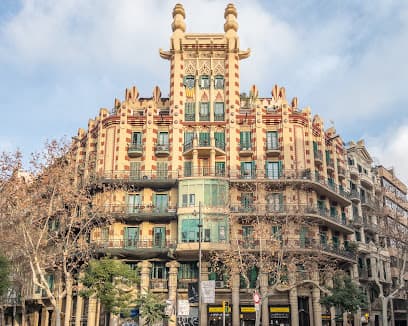
Walk down the C/ de Muntaner and you’ll see plenty of what makes Eixample famous: the orderly blocks, the wrought-iron balconies, the polite, bourgeois face of Barcelona. Then you hit the corner of Consell de Cent and everything goes sideways. You’re staring at Casa Xina—officially Casa Ferran Guardiola—and it looks like someone dropped a Viennese palace into a vat of Chinese lacquer and set the whole thing to 'hallucinate.'
Built in 1929 by Joan Francesc Guardiola Martínez for his brother Ferran, this isn't the organic, bone-like Modernisme of Gaudí. This is something else entirely. It’s a collision of styles that shouldn't work but somehow, through sheer architectural bravado, manages to dominate the street. You’ve got the geometric rigors of the Viennese Sezession movement—think clean lines and heavy forms—smashed together with a wild, unapologetic Orientalism. The locals didn't call it the 'Chinese House' because they were being poetic; they called it that because the red and yellow ceramics, the pagoda-like silhouettes, and the sheer garishness of the facade felt like a transmission from a distant, imagined East.
The facade is a riot of detail. Look up and you’ll see columns that look like they belong in a temple, topped with obelisks and strange, winged figures. The ceramic work is the star here—vibrant reds and ochres that catch the Mediterranean sun in a way that makes the surrounding grey stone buildings look like they’re mourning. It was finished just in time for the 1929 International Exposition, a period when Barcelona was desperate to show the world it could be modern, weird, and wealthy all at once. Guardiola Martínez wasn't interested in blending in; he wanted to leave a scar on the neighborhood, a beautiful, confusing mark that people would still be arguing about a century later.
Here’s the reality check: you aren't going inside. This isn't a museum with a gift shop and a tiered ticket price. It’s a residential building. People live here. They cook dinner, they argue about the laundry, and they probably get tired of tourists like us gawking at their windows from the sidewalk. There is no lobby tour, no rooftop bar, no 'immersive experience' with VR goggles. It is a piece of the city’s living skin. You stand on the corner, you dodge the commuters on their scooters, and you look up.
Is it worth the walk? If you’re tired of the same three Gaudí buildings appearing on every postcard, then yes, absolutely. It’s a reminder that Barcelona’s architectural history isn't a monolith. It’s messy, it’s experimental, and sometimes it’s just plain strange. It represents a moment in time when the city was looking outward, grabbing bits of Vienna and Beijing and shoving them into the Eixample grid just to see what would happen. What happened was Casa Xina—a glorious, red-tiled freak of nature that remains one of the most honest expressions of 1920s ego in the city. Don't just snap a photo and leave. Stand there for ten minutes. Watch how the light hits the ceramics. Realize that someone had the guts to build this in a neighborhood that values conformity above almost everything else. That’s the real magic of the place.
Type
Historical landmark, Tourist attraction
Duration
15-30 minutes
Best Time
Late afternoon for the best lighting on the facade
What People Say
orientalism(3)sezession(2)1929(2)architect(2)residential building(2)
Features
Historical landmark
Tourist attraction
Categories
ArchitectureArt DecoModernismePhotography
Ticket Prices
Free Admission
No tickets required
Must-See Highlights
The intricate red and yellow ceramic tile patterns
The 'pagoda' style roof elements and obelisks
The winged figures and geometric columns on the upper floors
The contrast between the building and its more traditional neighbors
Visitor Tips
Bring a zoom lens to capture the details of the upper balconies
Respect the residents—don't try to enter the lobby or buzz the intercom
Combine this with a visit to the nearby Ninot Market for a local lunch
Look at the building from across the street to appreciate the full scale of the corner design
Good For
Architecture buffsPhotographersBudget travelersHistory enthusiasts
Why Visit
Bizarre mashup of Viennese Sezession and Orientalist 'Chinese' aesthetics
Vibrant red and yellow ceramic facade that stands out from the grey Eixample grid
A rare, non-Gaudí architectural landmark from the 1929 International Exposition era
Nearby Landmarks
- 10-minute walk from Passeig de Gràcia
- 8-minute walk from Plaça de la Universitat
- 12-minute walk from Casa Batlló
- 5-minute walk from the Ninot Market
Accessibility
- Street-level viewing
- Wheelchair accessible sidewalk
Location
C/ de Muntaner, 54
Eixample, Barcelona
Nearby Hotels
Nearby Restaurants
In Eixample
ATTRACTION
Mural Margalef
Eixample
A towering splash of Mediterranean blue breaking the rigid geometry of Eixample, Joan Margalef’s mural is a visceral reminder that Barcelona’s soul isn't just in its museums.
0.0(0)
Tourist attraction
ATTRACTION
Mural Margalef
Eixample
A geometric middle finger to urban decay, this massive kinetic mural by Eduard Margalef turns a drab Eixample blind wall into a rhythmic, shifting explosion of optical art.
0.0(0)
Tourist attraction
ATTRACTION
Happy Foodies
Eixample
Forget the plastic-wrapped tourist traps; this is a deep dive into the grease, garlic, and soul of Catalan cooking where you actually learn to handle a knife and a porrón.
0.0(0)
Sightseeing tour agencyTour agency
Frequently Asked Questions
Is Casa Xina worth visiting?
Yes, if you appreciate eccentric architecture and want to see a side of Barcelona beyond Gaudí. It's a quick, free street-side viewing that offers some of the most unique photos in Eixample.
Can you go inside Casa Xina?
No, Casa Xina is a private residential building. There are no public tours or interior access, so you'll have to enjoy the spectacular facade from the sidewalk.
What is the best time to see Casa Xina?
Late afternoon is best, as the setting sun hits the red and yellow ceramic tiles on the facade, making the colors pop against the Eixample skyline.
How do I get to Casa Xina?
It's located at the corner of Carrer de Muntaner and Carrer del Consell de Cent. The nearest Metro stations are Universitat (L1, L2) or Passeig de Gràcia (L2, L3, L4), both about a 10-minute walk away.
Reviews
0 reviews for Casa Xina (Casa Ferran Guardiola)
No reviews yet. Be the first to share your experience!