4.7
7 verified reviews
About
Barcelona’s Eixample is a grid of ambition, a sprawling testament to a time when the city’s bourgeoisie had too much money and an obsessive need to outdo their neighbors. While the masses choke the sidewalks in front of the Gaudí blockbusters, the real soul of the city’s architectural explosion hides in plain sight on streets like Carrer de Mallorca. Casa Vallet i Xiró is one of those quiet survivors. Built between 1912 and 1913, it doesn’t scream for your attention with psychedelic colors or melting walls, but if you stop walking and actually look up, it’ll hit you right in the gut.
Designed by Josep Maria Barenys i Gambús, this building represents the sophisticated tail-end of the Modernisme movement. By 1913, the wild, organic frenzy of the early years was beginning to settle into something more structured, but no less detailed. This isn't a museum; it’s a living, breathing residential building. People live here. They cook dinner, argue about politics, and hang their laundry behind some of the most intricate stonework in the Eixample. There’s something honest about that—a masterpiece that still has to earn its keep as a place to sleep.
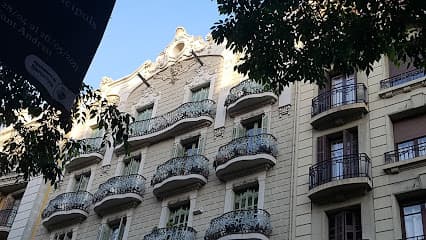
The facade is a masterclass in texture. You’ve got these heavy, rhythmic balconies with wrought iron that looks like it was twisted by a giant’s hand, and stone carvings that lean into the floral motifs the Catalans loved so much. It’s the kind of craftsmanship that makes modern glass-and-steel boxes look like the cheap, temporary shacks they are. When you stand across the street, you can see the hierarchy of the floors—the 'principal' floor with its grander openings, where the owners would have lived, looking down on the street with a sense of hard-earned entitlement.
Walking past Casa Vallet i Xiró is a necessary pause because it forces you to slow down. You aren't here to check a box on a 'top ten' list. You’re here to witness the ego and artistry of a city that refused to be ordinary. The Eixample was designed by Ildefons Cerdà to be a utopian, egalitarian space, but the architects of the Modernista era had other plans. They wanted drama. They wanted stone that looked like lace. Barenys i Gambús delivered exactly that, tucked away between a pharmacy and a cafe.
Is it worth the detour? If you give a damn about how a city expresses its identity through stone and iron, then yes. It’s a five-minute walk from the more famous Casa Thomas and Palau Montaner, making it a crucial stop on any serious architecture crawl through the Quadrat d'Or. You won't find a gift shop here, and nobody is going to sell you a plastic miniature of the building. It’s just you, the traffic of Carrer de Mallorca, and a century-old wall of carved stone that reminds you that once upon a time, we built things to last forever. It’s a reminder that even in a city as trampled by tourism as Barcelona, there are still corners where the history feels raw and the beauty feels unearned. Don't just take a photo and move on. Stand there. Look at the way the light hits the carvings at 10:00 AM. That’s the real Barcelona.
Type
Historical landmark, Tourist attraction
Duration
15-30 minutes
Best Time
Morning for the best light on the facade
Features
Historical landmark
Tourist attraction
Categories
ArchitectureModernismeHistorical Site
Ticket Prices
Free Admission
No tickets required
Must-See Highlights
Intricate wrought iron balcony railings
Floral stone carvings typical of late Modernisme
The grand 'Principal' floor windows
The rhythmic symmetry of the upper balconies
Visitor Tips
Bring a zoom lens to capture the details of the upper floor carvings
Combine this with a visit to the nearby Casa Thomas and Palau Montaner for a complete architecture circuit
Respect the residents; it is a private home, so keep noise levels down while admiring the exterior
Good For
Architecture enthusiastsPhotographersHistory buffsBudget travelers
Why Visit
Authentic 1913 Modernista facade by architect Josep Maria Barenys i Gambús
Located in the heart of the 'Quadrat d'Or', Barcelona's most prestigious architectural district
A quiet, non-touristy alternative to the crowded Gaudí landmarks
Nearby Landmarks
- 1-minute walk from Casa Thomas
- 3-minute walk from Palau Montaner
- 10-minute walk from Casa Milà (La Pedrera)
- 12-minute walk from Sagrada Família
Accessibility
- Visible from the public sidewalk
- Flat terrain on Carrer de Mallorca
Location
Carrer de Mallorca, 302
Eixample, Barcelona
Nearby Hotels
Nearby Restaurants
In Eixample
ATTRACTION
Mural Margalef
Eixample
A towering splash of Mediterranean blue breaking the rigid geometry of Eixample, Joan Margalef’s mural is a visceral reminder that Barcelona’s soul isn't just in its museums.
0.0(0)
Tourist attraction
ATTRACTION
Mural Margalef
Eixample
A geometric middle finger to urban decay, this massive kinetic mural by Eduard Margalef turns a drab Eixample blind wall into a rhythmic, shifting explosion of optical art.
0.0(0)
Tourist attraction
ATTRACTION
Happy Foodies
Eixample
Forget the plastic-wrapped tourist traps; this is a deep dive into the grease, garlic, and soul of Catalan cooking where you actually learn to handle a knife and a porrón.
0.0(0)
Sightseeing tour agencyTour agency
Frequently Asked Questions
Is Casa Vallet i Xiró worth visiting?
Yes, especially if you want to see authentic Modernista architecture without the massive crowds of the more famous Gaudí sites. It is a preserved example of 1913 craftsmanship.
Can you go inside Casa Vallet i Xiró?
Generally, no. It is a private residential building. Visitors typically enjoy the intricate facade and stonework from the street as part of an architecture walking tour.
How do I get to Casa Vallet i Xiró?
The building is located at Carrer de Mallorca, 302. The nearest metro stations are Girona (L4) and Verdaguer (L4, L5), both about a 5-minute walk away.
What is the best time to see the building?
Morning light is best for photographing the facade, as the sun hits the stone carvings and wrought iron details directly, highlighting the textures.
Reviews
0 reviews for Casa Vallet I Xiró
No reviews yet. Be the first to share your experience!