5.0
1 verified reviews
About
If you want the sanitized, gift-wrapped version of Barcelona, stay in the Eixample. But if you want the real thing—the smell of roasting chickens, the roar of a thousand scooters, and the grit of a neighborhood that still knows how to work for a living—you get on the Blue Line and head to Sants. Right there, on the relentless commercial artery of Carrer de Sants, sits Casa Tomàs Vendrell. It’s an architectural flex from a time when this neighborhood was still deciding if it wanted to be part of the big city or remain its own stubborn, independent village.
Built between 1900 and 1902 by architect Jaume Gustà i Bondia, this place is a visual jolt. You’re walking past discount shoe stores and mobile phone repair shops, and suddenly, there it is: a stone-and-iron middle finger to the mundane. It’s pure Modernisme, but without the three-hour queue or the selfie-stick-wielding hordes that plague the Block of Discord. This is architecture for the people who actually live here, a reminder that even in a working-class stronghold, someone once had the audacity to demand beauty.
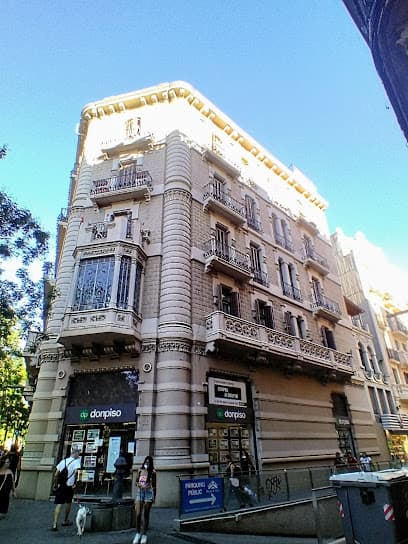
Look at the facade. It’s not just stone; it’s a living thing. The floral motifs crawl up the walls like they’re trying to reclaim the building for the earth. The wrought iron work on the balconies is the kind of craftsmanship that makes you realize how much we’ve lost in our era of glass and steel. It’s intricate, heavy, and honest. The central 'tribuna'—that enclosed glass gallery—is the star of the show, a classic Barcelona feature designed for people-watching without being seen, which is the city’s unofficial national sport.
Sants was once a town of chimneys and textile mills, a place of labor and radical politics. When wealthy owners like Tomàs Vendrell commissioned buildings like this, they weren't just building houses; they were planting flags. They were saying that Sants had arrived. Today, the building serves as a silent witness to the neighborhood's evolution. It’s weathered, sure. It’s got the patina of a century of exhaust fumes and Mediterranean sun, but that only makes it better. It’s not a museum piece; it’s a survivor.
You can’t go inside—it’s a private residence, and frankly, that’s for the best. There’s no gift shop selling Gaudí-themed thimbles here. You stand on the sidewalk, dodge a grandmother with a shopping trolley, and look up. You appreciate the curve of the stone, the rhythm of the windows, and the way the light hits the carvings in the late afternoon. It’s a reminder that great art doesn't always require a ticket; sometimes, it just requires you to stop looking at your phone and pay attention to the street.
Is Casa Tomàs Vendrell worth the trip? If you’re an architecture nerd or someone who finds the 'official' tourist trail a bit too suffocating, then yes, absolutely. It’s a gateway drug to the rest of Sants. Once you’ve stared at the facade, wander down to the Mercat de Sants, a brick-and-iron cathedral of food that puts the Boqueria to shame for sheer authenticity. Grab a vermut at a corner bar where the floor is littered with napkins and the bartender doesn't care about your Instagram following. That’s the Barcelona I care about, and Casa Tomàs Vendrell is the perfect place to start finding it.
Type
Tourist attraction
Duration
15-30 minutes
Best Time
Late afternoon for the best light on the facade
Features
Tourist attraction
Categories
ArchitectureModernismeHistoric Site
Ticket Prices
Free Admission
No tickets required
Must-See Highlights
The ornate central 'tribuna' (glass gallery)
Intricate wrought iron balcony railings
Floral stone carvings around the window frames
The decorative crown at the top of the facade
Visitor Tips
Combine this with a visit to the nearby Mercat de Sants for a true local experience
Keep an eye on your belongings as Carrer de Sants is a very busy shopping thoroughfare
Look across the street to get a full-frame view of the building's height and symmetry
Good For
Architecture enthusiastsPhotography loversOff-the-beaten-path explorersBudget travelers
Why Visit
Crowd-free Modernisme in a real working-class neighborhood
Masterful wrought iron and stone floral motifs by Jaume Gustà i Bondia
Located on Carrer de Sants, one of Europe's longest and most active commercial streets
Nearby Landmarks
- 2-minute walk from Plaça de Sants
- 5-minute walk from Mercat de Sants
- 12-minute walk from Sants Estació (Main Train Station)
- 15-minute walk from Parc de l'Espanya Industrial
Accessibility
- Viewable from the public sidewalk
- Flat terrain on Carrer de Sants
Location
Carrer de Sants, 149
Sants-Montjuïc, Barcelona
Nearby Hotels
Nearby Restaurants
In Sants-Montjuïc
ATTRACTION
Bolets1
Sants-Montjuïc
A gritty, earthy temple to the Catalan obsession with wild mushrooms, where the dirt is real, the fungi are seasonal gold, and the air smells like the damp floor of a Pyrenean forest.
0.0(0)
Tourist attraction
ATTRACTION
Montjuic aparca
Sants-Montjuïc
The unglamorous base camp for your Montjuïc assault. A tactical slab of asphalt where the city's chaos fades into the pine-scented ghosts of the 1992 Olympics.
0.0(0)
Tourist attraction
ATTRACTION
Паркінг Барселона
Sants-Montjuïc
A sprawling slab of industrial reality in the Zona Franca. No Gaudí here—just hot asphalt, diesel fumes, and the honest utility of a secure place to park your rig.
0.0(0)
Park
Frequently Asked Questions
Is Casa Tomàs Vendrell worth visiting?
Yes, if you appreciate Modernista architecture and want to see it in an authentic, non-touristy neighborhood. It's a stunning facade that you can enjoy for free while exploring the grit and soul of Sants.
Can you go inside Casa Tomàs Vendrell?
No, the building is a private residence and is not open to the public for interior tours. The attraction is the exterior facade and its intricate architectural details.
How do I get to Casa Tomàs Vendrell?
The easiest way is via the Barcelona Metro. Take the L1 (Red Line) or L5 (Blue Line) to the Plaça de Sants station; the building is just a short 2-minute walk from the exit.
What is the best time to see the building?
Morning or late afternoon provides the best light for photographing the stone carvings and wrought iron. Since it's on a busy shopping street, visiting during the day allows you to soak up the local neighborhood energy.
Reviews
0 reviews for Casa Tomàs Vendrell
No reviews yet. Be the first to share your experience!