3.8
4 verified reviews
About
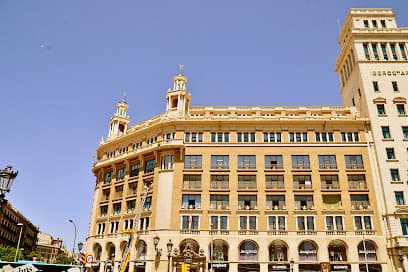
Plaça de Catalunya is the chaotic, pigeon-infested heart of Barcelona. It’s the drain where every tourist, pickpocket, and street performer eventually washes up. It’s loud, it’s messy, and most people treat it as a transit hub to be escaped as quickly as possible. But if you stop looking for the nearest metro entrance and cast your eyes toward the corner of Rambla de Catalunya, you’ll see Casa Pich i Pon. It is a stoic, muscular palate cleanser in a city often drunk on Gaudí’s curves.
Built between 1919 and 1921, this isn’t the flowery, gothic-revival-on-acid style that made Josep Puig i Cadafalch famous with Casa Amatller. By the time he got to this project, the architect was moving on. He was looking at the Chicago School, at the burgeoning skyscrapers of America, and at a new sense of order. This building marks the pivot point from the floral madness of Modernisme to the disciplined, classical lines of Noucentisme. It sits on the corner like a heavyweight boxer in a tuxedo—elegant, but capable of taking a punch from the surrounding urban sprawl.
The man who commissioned it, Joan Pich i Pon, was a character straight out of a satirical novel. A businessman and politician who served as the Mayor of Barcelona, he was legendary for his 'pichiponades'—linguistic blunders that made him the laughingstock of the city’s high society. He once reportedly confused 'typhoid fever' with 'tropical fever' and referred to the 'Stockholm syndrome' in ways that made no sense. But while he struggled with syntax, the man had an eye for real estate and talent. He wanted a building that screamed 'I have arrived,' and Puig i Cadafalch delivered a landmark that has outlasted every one of Pich i Pon’s verbal gaffes.
Architecturally, the building was a pioneer. It was one of the first in Barcelona to utilize a reinforced concrete internal structure, which allowed for those expansive, rhythmic windows that soak up the Mediterranean sun. The facade is a masterclass in restrained power, topped with a temple-like structure on the roof that looks like it was plucked from the Acropolis and dropped onto a 20th-century office block. It’s a strange, beautiful juxtaposition that perfectly captures the ambition of Barcelona at the time.
Here’s the honest truth: you can’t go inside and poke around the offices. This isn’t a Disney-fied Gaudí theme park where you pay thirty euros to see a tiled chimney and buy a miniature ceramic lizard. Casa Pich i Pon is a working building. It houses the offices of the European Commission and various private firms. People actually work here for a living, which, in the middle of the Eixample’s tourist hurricane, feels like a radical act of normalcy.
Is Casa Pich i Pon worth visiting? If you’re the kind of person who needs an interactive VR experience and a gift shop to feel like you’ve 'seen' something, then no. But if you give a damn about the soul of a city and how it evolved from medieval claustrophobia to modern ambition, then stand across the street and just look at it. It’s a reminder that even in the most crowded square in the city, there is still dignity to be found in the stone. It’s a piece of the real Barcelona, standing tall while the pigeons and the tourists swirl below.
Type
Tourist attraction
Duration
15-30 minutes
Best Time
Late afternoon when the sun hits the facade, highlighting the rhythmic balconies and rooftop temple.
Features
Tourist attraction
Categories
ArchitectureModernismeNoucentisme
Ticket Prices
Free Admission
No tickets required
Must-See Highlights
The rooftop 'temple' structure
The rhythmic, deep-set balconies
The reinforced concrete facade design
Visitor Tips
Stand on the opposite side of Plaça de Catalunya near the fountains to get the best angle for photos.
Look for the contrast between this building and the more ornate Modernist buildings further up Passeig de Gràcia.
Combine this with a walk down Rambla de Catalunya for a more local feel than the main Rambla.
Good For
Architecture loversHistory buffsPhotographers
Why Visit
A rare example of Puig i Cadafalch's transition to the Chicago School-influenced Noucentisme style
Strategic corner location offering one of the best architectural views of Plaça de Catalunya
Historical connection to the eccentric Barcelona mayor Joan Pich i Pon
Nearby Landmarks
- 1-minute walk from Plaça de Catalunya
- 2-minute walk from the Apple Store Passeig de Gràcia
- 5-minute walk from Casa Amatller
- 1-minute walk from El Corte Inglés
Accessibility
- Viewable from the street level
- Plaça de Catalunya is fully accessible
Location
Pl. de Catalunya, 9
Eixample, Barcelona
Nearby Hotels
Nearby Restaurants
In Eixample
ATTRACTION
Mural Margalef
Eixample
A towering splash of Mediterranean blue breaking the rigid geometry of Eixample, Joan Margalef’s mural is a visceral reminder that Barcelona’s soul isn't just in its museums.
0.0(0)
Tourist attraction
ATTRACTION
Mural Margalef
Eixample
A geometric middle finger to urban decay, this massive kinetic mural by Eduard Margalef turns a drab Eixample blind wall into a rhythmic, shifting explosion of optical art.
0.0(0)
Tourist attraction
ATTRACTION
Happy Foodies
Eixample
Forget the plastic-wrapped tourist traps; this is a deep dive into the grease, garlic, and soul of Catalan cooking where you actually learn to handle a knife and a porrón.
0.0(0)
Sightseeing tour agencyTour agency
Frequently Asked Questions
Is Casa Pich i Pon worth visiting?
Yes, for architecture enthusiasts who want to see the transition from Modernisme to Noucentisme. While you can't tour the interior, the exterior is a significant work by Puig i Cadafalch.
Can you go inside Casa Pich i Pon?
No, the building is currently used for private offices and the European Commission representation, so it is not open for public tours.
What is the history of Casa Pich i Pon?
Built in 1921 by Josep Puig i Cadafalch, it was a renovation of an older building for politician Joan Pich i Pon, showcasing early 20th-century American architectural influences.
Where is Casa Pich i Pon located?
It is located at Plaça de Catalunya, 9, on the corner of Rambla de Catalunya in the Eixample district.
Reviews
0 reviews for Casa Pich i Pon
No reviews yet. Be the first to share your experience!