4.4
104 verified reviews
About
You don’t come to Sant Gervasi to follow the herd. You come here to escape the sweaty, selfie-stick-waving masses choking the life out of the Gothic Quarter. You come here because you want to see the Barcelona that doesn’t care if you’re looking at it or not. And then, on a narrow, unassuming street called Carrer de Pàdua, you hit number 77, and it feels like the city just slapped you across the face with a bouquet of ceramic lilies.
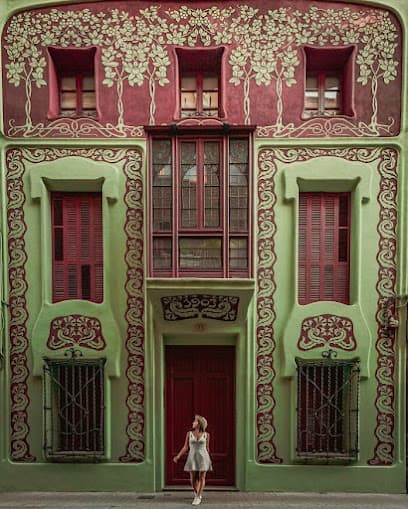
Casa Pàdua is a hallucinogenic trip of a building. Built in 1903 by Jeroni Granell i Manresa—a man who clearly had no interest in the beige sensibilities of his neighbors—it stands as a defiant, vertical garden of brick and tile. It’s not Gaudí, and frankly, that’s a relief. While Gaudí was busy trying to make stone look like melting wax, Granell was playing a different game. He was the master of the stained glass at the Palau de la Música Catalana, and you can see that same obsession with light and color bleeding into the very skin of this house.
The facade is a riot. You’ve got these deep, blood-red bricks acting as the skeleton, holding together panels of white and forest-green floral tiles that look like they were stolen from a Victorian conservatory. It’s loud. It’s garish. It’s beautiful in the way a perfectly aged bottle of absinthe is beautiful—slightly dangerous and entirely intoxicating. The wrought iron balconies don’t just sit there; they twist and crawl like vines trying to reclaim the masonry. It’s the kind of architecture that makes you realize how much we’ve lost in our modern era of glass boxes and 'functional' living.
Here’s the cold, hard truth: you can’t go inside. Don’t go rattling the handle or peering through the keyhole like a creep. This is a private residence, or at least a private space, and the people inside are busy living lives that don't involve you. You are a voyeur here, standing on a sidewalk that’s barely wide enough for two people to pass, looking up at a masterpiece that doesn't have a gift shop or a guided tour. And that’s exactly why it’s worth the trip. There is no 'experience' being sold to you here. There are no velvet ropes. It’s just you, the street, and a 120-year-old dream of what a house could be.
The neighborhood of Sant Gervasi-Galvany is the perfect backdrop for this. It’s wealthy, it’s quiet, and it smells like expensive laundry detergent and old money. Walking here feels like you’ve finally stepped behind the curtain of the tourist theater. You’ll see locals carrying baguettes, old women walking tiny dogs with more attitude than a Michelin-starred chef, and the occasional student rushing to a nearby school. They walk past Casa Pàdua without a second glance. To them, it’s just the neighborhood weirdo. To you, it’s a reminder that even in a city as picked-over as Barcelona, there are still secrets hiding in plain sight.
Is Casa Pàdua worth the detour? If you’re the kind of person who needs a headset and a map to tell you what’s important, probably not. But if you’re looking for a hit of pure, unadulterated Modernisme without the three-hour wait, then yes. Grab a coffee at a nearby corner bar, walk up the hill, and just stand there for ten minutes. Look at the way the light hits the green ceramics. Notice the precision of the brickwork. It’s a short, sharp shock of brilliance in a world that’s increasingly gray. Then, turn around and walk away before the residents start wondering why you’re staring at their windows.
Type
Tourist attraction
Duration
15-30 minutes
Best Time
Morning for the best photographic light on the facade
What People Say
facade(8)architecture(4)photo(4)1903(3)modernisme(2)1970s(2)lab(2)perfume(2)
Features
Tourist attraction
Categories
ModernismeArchitectureOff the Beaten PathPhotography
Ticket Prices
Free Admission
No tickets required
Must-See Highlights
The intricate green and white floral ceramic tiles
The contrasting red brickwork typical of early 1900s Catalan design
The ornate wrought iron balcony railings
The original wooden door with Modernista carvings
Visitor Tips
Combine this with a visit to Casa Vicens, which is just a short walk away
Respect the residents' privacy and keep noise levels down while photographing
Look up at the eaves to see the detailed ceramic work under the roofline
Good For
Architecture loversPhotographersSolo travelersBudget travelers
Why Visit
Striking green and white floral ceramic facade
Designed by Jeroni Granell, the master of Palau de la Música's stained glass
Zero crowds compared to Eixample's Modernista landmarks
Nearby Landmarks
- 12-minute walk from Casa Vicens (Gaudí's first house)
- 10-minute walk from Mercat de Galvany
- 2-minute walk from Pàdua FGC Station
Accessibility
- Viewable from the public sidewalk
- Street is narrow but paved
Location
Carrer de Pàdua, 77
Sarrià-Sant Gervasi, Barcelona
Nearby Hotels
Nearby Restaurants
In Sarrià-Sant Gervasi
ATTRACTION
Casa Narcís Bosch
Sarrià-Sant Gervasi
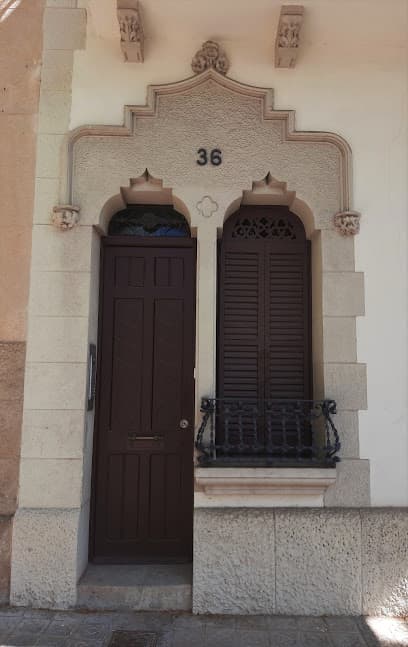
A Modernista fever dream tucked away in Sarrià, where Salvador Valeri i Pupurull’s stone curves and ironwork prove that Gaudí wasn't the only genius in town.
0.0(0)
Tourist attraction
ATTRACTION
Plaça de Calvó
Sarrià-Sant Gervasi
A quiet, unpretentious slice of Sant Gervasi where the only drama is a toddler losing a shoe. No Gaudí, no crowds, just trees, benches, and the sound of real life in the Zona Alta.
0.0(0)
Park
ATTRACTION
Pipican Piscines i Esports
Sarrià-Sant Gervasi
A dirt-caked arena of canine chaos set against the polished backdrop of Sarrià-Sant Gervasi, where the neighborhood’s elite and their four-legged shadows come to settle scores.
0.0(0)
Park
Frequently Asked Questions
Is Casa Pàdua worth visiting?
Yes, if you are an architecture enthusiast looking for a quiet, authentic Modernista site away from the crowds. It only takes 10-15 minutes to appreciate the facade, making it a great quick stop.
Can you go inside Casa Pàdua?
No, the building is a private residence and is not open to the public. Visitors can only view the stunning floral facade from the street.
How do I get to Casa Pàdua?
The easiest way is to take the FGC (Ferrocarrils) to the Pàdua station. From there, it is a short 2-minute walk to the building at Carrer de Pàdua, 77.
What is the best time to see Casa Pàdua?
Morning light is best for photography, as the sun hits the green and white tiles directly, making the colors pop against the red brick.
Reviews
0 reviews for Casa Pàdua
No reviews yet. Be the first to share your experience!