5.0
2 verified reviews
About
Poble-sec is not the Barcelona they sell you in the glossy brochures. It’s not the manicured, sun-drenched fantasy of the Eixample or the Gothic Quarter’s Disneyfied labyrinth. This is a neighborhood that earned its name—the 'Dry Village'—by being the place where the water didn't reach, a working-class sprawl tucked under the shadow of Montjuïc. It’s a place of grit, of steep streets, and of Carrer de Blai, where you can still find a decent pincho without selling a kidney. But right there, at Carrer de Blasco de Garay, 24, stands Casa Montserrat Gili, a sudden, violent burst of Modernista beauty that feels like finding a silk handkerchief in a boxing gym.
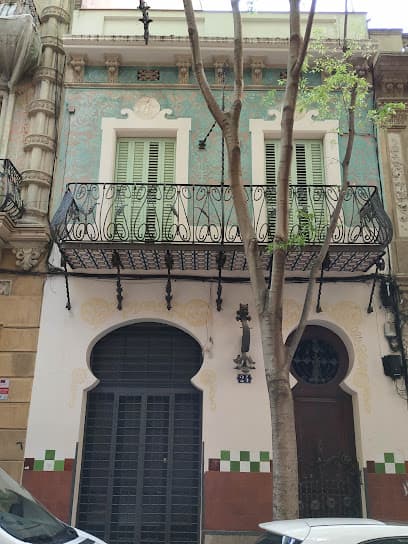
Built between 1904 and 1905, this isn't Gaudí, and thank God for that. This is the work of Manuel Joaquim Raspall i Mayol, a man who understood that if you’re going to build for the bourgeoisie in a neighborhood of laborers, you’d better make it count. Raspall was a master of the 'sgraffito'—that painstaking technique of layering plaster and etching into it to reveal the colors beneath. On the facade of Casa Montserrat Gili, he went to town. We’re talking about intricate floral motifs that crawl up the walls like ivy, framed by the kind of wrought ironwork that makes modern construction look like it was assembled from a Lego kit by a bored toddler.
When you stand across the street, you’re not looking at a museum. You’re looking at a living, breathing residential building. There are no velvet ropes here. There are no gift shops selling overpriced magnets. There’s just the rhythmic thrum of Poble-sec life: a scooter buzzing past, the smell of frying garlic from a nearby kitchen, and the occasional local wondering why the hell you’re staring at their front door. The building’s balconies are the stars of the show—curvaceous, organic, and defiant. They represent a time when even a private residence was an opportunity to make a statement, a way for the Gili family to say, 'We’ve arrived, and we’ve brought art with us.'
The real magic of Casa Montserrat Gili is the contrast. You have these delicate, whipped-cream architectural details sitting right against the hard-edged reality of a neighborhood that has spent a century reinventing itself. It’s a reminder that Barcelona’s greatness isn't just in its grand cathedrals or its sprawling parks, but in these quiet, unexpected corners where a single architect decided to do something extraordinary. Raspall’s work here is a bridge between the flamboyant Modernisme of the city center and the more restrained, suburban style he would later perfect in places like La Garriga.
Is it worth the trek? If you’re the kind of person who needs an audio guide and a souvenir ticket to feel like you’ve 'seen' something, then no, stay on the tour bus. But if you want to see the real Barcelona—the one where beauty lives in the streets and history is etched into the very plaster of the houses people still sleep in—then yes. Walk up from the Paral·lel, dodge the tourists on Blai, and find this place. Stand there for ten minutes. Look at the way the light hits the ceramic tiles. Then go find a bar that doesn't have a menu in English, order a vermut, and appreciate the fact that some of the best things in this city are still free and hiding in plain sight. It’s a small, perfect slice of the Catalan soul, served without the pretense.
Type
Tourist attraction
Duration
15-30 minutes
Best Time
Morning for the best light on the facade
Features
Tourist attraction
Categories
ArchitectureModernismeHistory
Ticket Prices
Free Admission
No tickets required
Must-See Highlights
The intricate floral sgraffito patterns on the upper floors
The curved wrought iron balconies
The colorful ceramic tile details near the roofline
Visitor Tips
Combine this with a pincho crawl on nearby Carrer de Blai
Look up to see the most detailed plasterwork near the top of the building
Respect the residents by keeping noise levels down while viewing
Good For
Architecture enthusiastsPhotography loversBudget travelersOff-the-beaten-path explorers
Why Visit
Masterful sgraffito work by Manuel Joaquim Raspall
Authentic, non-touristy Poble-sec neighborhood setting
Exquisite example of early 20th-century Catalan Modernisme
Nearby Landmarks
- 5-minute walk from Carrer de Blai (Tapas Street)
- 8-minute walk from Refugi 307 (Air Raid Shelter)
- 10-minute walk from Teatre Condal
- 12-minute walk from Jardins de les Tres Xemeneies
Accessibility
- Visible from the sidewalk
- Flat street access
Location
Carrer de Blasco de Garay, 24
Sants-Montjuïc, Barcelona
Nearby Hotels
Nearby Restaurants
In Sants-Montjuïc
ATTRACTION
Bolets1
Sants-Montjuïc
A gritty, earthy temple to the Catalan obsession with wild mushrooms, where the dirt is real, the fungi are seasonal gold, and the air smells like the damp floor of a Pyrenean forest.
0.0(0)
Tourist attraction
ATTRACTION
Montjuic aparca
Sants-Montjuïc
The unglamorous base camp for your Montjuïc assault. A tactical slab of asphalt where the city's chaos fades into the pine-scented ghosts of the 1992 Olympics.
0.0(0)
Tourist attraction
ATTRACTION
Паркінг Барселона
Sants-Montjuïc
A sprawling slab of industrial reality in the Zona Franca. No Gaudí here—just hot asphalt, diesel fumes, and the honest utility of a secure place to park your rig.
0.0(0)
Park
Frequently Asked Questions
Can you go inside Casa Montserrat Gili?
No, Casa Montserrat Gili is a private residential building. Visitors can only admire the stunning Modernista facade and architectural details from the street.
Who was the architect of Casa Montserrat Gili?
The building was designed by Manuel Joaquim Raspall i Mayol, a prominent Catalan Modernista architect known for his intricate sgraffito work and floral designs.
Is there an entrance fee for Casa Montserrat Gili?
There is no fee as the attraction is the building's exterior. It is a public architectural site located on a residential street in Poble-sec.
What is the best time to photograph the building?
The facade is best viewed in the morning or early afternoon when the sunlight hits the sgraffito and ceramic details, highlighting the textures and colors.
Reviews
0 reviews for Casa Montserrat Gili
No reviews yet. Be the first to share your experience!