4.0
1 verified reviews
About
Sants is not the Barcelona they sell you on the back of a bus tour ticket. It’s not the polished, limestone-scrubbed fantasy of the Gothic Quarter or the high-rent catwalk of Passeig de Gràcia. Sants is a place of noise, of commerce, of people who actually live here and couldn’t care less about your selfie stick. It’s a neighborhood that was an independent village until the late 19th century, and it still carries that 'don’t mess with us' energy. Right in the thick of it, on the roaring artery of Carrer de Sants, sits Casa Miquel Tusset.
Built in 1911, this isn’t a Gaudí fever dream. It’s the work of Modest Feu i Estrada, a man who essentially designed the visual DNA of this neighborhood. While the big names were busy building palaces for textile barons uptown, Feu was here, proving that the working-class districts deserved beauty too. Casa Miquel Tusset is a middle finger to the idea that art is only for the wealthy. It’s a three-story testament to Catalan Modernisme, but with a grounded, sturdy sensibility that matches the people walking past its front door every day.
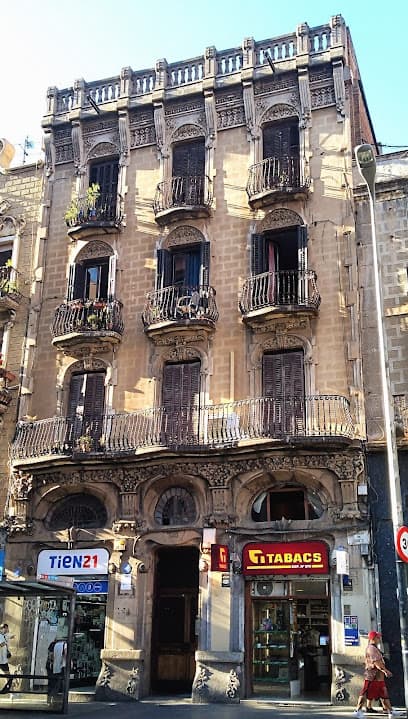
Stand across the street and look up. You have to look past the neon signs of the ground-floor shops—currently occupied by an optician, because life goes on—to see the real soul of the place. The facade is a riot of stone carvings and floral motifs that seem to sprout directly from the masonry. The wrought iron on the balconies isn’t just functional; it’s delicate, twisted into shapes that mimic the organic world, a hallmark of the era. There’s a rhythm to the windows, a symmetry that feels intentional and proud. It’s the kind of building that makes you realize that a hundred years ago, even a residential block was an opportunity to make a statement.
Feu was a local hero, a prolific architect who understood the scale of Sants. He didn't try to build a cathedral; he built a home that reflected the aspirations of a rising middle class in a district defined by factories and labor. When you look at the details—the way the stone is worked around the window frames, the specific curve of the roofline—you’re seeing the hand of a craftsman who gave a damn. It’s visceral, honest architecture. It’s weathered the Spanish Civil War, the gray years of the dictatorship, and the relentless march of modernization, yet it still stands there, looking down at the commuters and the shoppers with a quiet, stone-faced dignity.
Coming here is a lesson in observation. There are no velvet ropes. There are no audio guides whispering platitudes in your ear. There is no entrance fee because you can’t go inside—it’s a private residence. You are standing on a busy sidewalk, dodging grandmothers with shopping carts and teenagers on scooters. The air smells of roasted coffee from the nearby cafes and the faint metallic tang of the metro breathing through the grates. This is the real deal. It’s a reminder that the best things in Barcelona are often hiding in plain sight, tucked between a bakery and a bank, waiting for someone to stop looking at their phone and start looking at the sky.
If you’re the kind of traveler who needs a gift shop and a guided tour to feel like you’ve 'seen' something, stay in the center. But if you want to understand how this city actually breathes, take the L1 metro to Plaça de Sants and walk a few blocks. Casa Miquel Tusset is a window into a version of Barcelona that refuses to be a museum. It’s beautiful, it’s slightly soot-stained, and it’s absolutely authentic. It’s a piece of history that still has to work for a living, and there’s something deeply respectable about that.
Type
Tourist attraction
Duration
15-30 minutes
Best Time
Morning or late afternoon for the best light on the facade without the midday sun glare.
Features
Tourist attraction
Categories
ArchitectureModernismeHistory
Ticket Prices
Free Admission
No tickets required
Opening Hours
- MondayOpen 24 hours
- TuesdayOpen 24 hours
- WednesdayOpen 24 hours
- ThursdayOpen 24 hours
- FridayOpen 24 hours
- SaturdayOpen 24 hours
- SundayOpen 24 hours
Must-See Highlights
Intricate floral stone carvings around the windows
Ornate wrought iron balcony railings
The contrast between the 1911 upper floors and modern street-level commerce
Visitor Tips
Bring a zoom lens to capture the high-level stone details
Combine this with a visit to the nearby Mercat de Sants for a real local experience
Watch your pockets—Carrer de Sants is a busy commercial street
Good For
Architecture loversSolo travelersBudget travelersPhotography enthusiasts
Why Visit
Authentic 'Working-Class' Modernisme
Masterpiece by neighborhood architect Modest Feu
Zero crowds and no tourist traps
Nearby Landmarks
- Mercat de Sants (5-minute walk)
- Plaça de Sants (3-minute walk)
- Parc de l'Espanya Industrial (10-minute walk)
- Sants Estació (12-minute walk)
Accessibility
- Viewable from public sidewalk
- Flat terrain on Carrer de Sants
Location
Carrer de Sants, 130
Sants-Montjuïc, Barcelona
Nearby Hotels
Nearby Restaurants
In Sants-Montjuïc
ATTRACTION
Bolets1
Sants-Montjuïc
A gritty, earthy temple to the Catalan obsession with wild mushrooms, where the dirt is real, the fungi are seasonal gold, and the air smells like the damp floor of a Pyrenean forest.
0.0(0)
Tourist attraction
ATTRACTION
Montjuic aparca
Sants-Montjuïc
The unglamorous base camp for your Montjuïc assault. A tactical slab of asphalt where the city's chaos fades into the pine-scented ghosts of the 1992 Olympics.
0.0(0)
Tourist attraction
ATTRACTION
Паркінг Барселона
Sants-Montjuïc
A sprawling slab of industrial reality in the Zona Franca. No Gaudí here—just hot asphalt, diesel fumes, and the honest utility of a secure place to park your rig.
0.0(0)
Park
Frequently Asked Questions
Is Casa Miquel Tusset worth visiting?
Yes, if you are an architecture enthusiast or want to see authentic Catalan Modernisme outside the tourist-heavy center. It is a stunning facade that represents the neighborhood's historical pride.
Can you go inside Casa Miquel Tusset?
No, the building is a private residence. You can only view and photograph the exterior facade from the public sidewalk on Carrer de Sants.
How do I get to Casa Miquel Tusset?
Take the Metro L1 (Red Line) or L5 (Blue Line) to the Plaça de Sants station. The building is a short 3-minute walk away at Carrer de Sants, 130.
Who was the architect of Casa Miquel Tusset?
It was designed by Modest Feu i Estrada, a prolific architect who was instrumental in shaping the Modernista identity of the Sants neighborhood in the early 20th century.
Reviews
0 reviews for Casa Miquel Tusset
No reviews yet. Be the first to share your experience!