5.0
2 verified reviews
About
Passeig de Gràcia is a street that smells of ambition, high-octane exhaust, and the kind of perfume that costs more than your first car. It’s the spine of the Eixample, a grid of stone and ego where Barcelona’s industrial titans once competed to see who could build the most elaborate middle finger to their neighbors. And right there, at number 27, sits Casa Malagrida. It doesn’t have the hallucinogenic curves of Gaudí or the floral explosions of Domènech i Montaner, but it has something else: the heavy, unmistakable weight of tobacco money.
Built between 1905 and 1908, this place is the architectural equivalent of a gold watch. The man behind the checkbook was Manuel Malagrida, a guy who went to Argentina, made a killing in the tobacco trade, and came back to Barcelona to make sure everyone knew exactly how well he’d done. He hired Joaquim Codina i Matalí to build him a palace that bridged his two worlds. Look up at the facade and you’ll see it—the Andean condor of Argentina and the Spanish eagle carved into the stone, side-by-side, along with the flags of both nations. It’s a literal map of a man’s bank account, etched into the limestone of the Eixample.
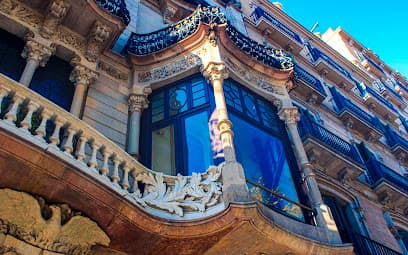
While the crowds are a few doors down, losing their collective minds and elbowing each other for the perfect selfie in front of Casa Batlló, Casa Malagrida sits in relative silence. It’s a private building, which means you aren’t getting past the front door unless you’re delivering mail or know someone with a very expensive lease. You’re here for the exterior, the street-level theater of it all. The ironwork on the balconies is intricate, the kind of craftsmanship that feels like a lost language in our era of glass and steel. The top of the building is crowned with a dome that looks like it belongs on a much larger monument, a final flourish of 'look at me' from a man who clearly never wanted to be ignored.
You can’t understand the Eixample without looking at places like this. It wasn’t just about art; it was about the 'Indiano'—the Spaniards who struck it rich in the Americas and returned to the motherland to spend it as loudly as possible. Malagrida wasn't just building a house; he was building a legacy. The details are obsessive. The sculptures aren't just decorative; they are narrative. They tell the story of a guy who conquered the tobacco fields of the New World and came home to claim his spot on the most expensive street in Spain.
Is it worth the stop? If you’re the kind of person who only wants the hits—the Sagrada Famílias and the Park Güells—then keep walking. But if you want to see the real fabric of Barcelona, the stuff that isn't wrapped in a gift shop bow, then stand on the sidewalk for five minutes. Look at the condor. Look at the eagle. Think about the smell of cigar smoke and the sheer, unadulterated gall it took to build something this permanent just to say 'I was here.' It’s a reminder that behind every beautiful facade in this city, there’s usually a story of a guy who worked harder, moved faster, and wanted it more than everyone else.
Type
Tourist attraction
Duration
15-30 minutes
Best Time
Morning for the best light on the facade
Features
Tourist attraction
Categories
ArchitectureModernismeHistory
Ticket Prices
Free Admission
No tickets required
Must-See Highlights
The stone-carved condor and eagle representing Argentina and Spain
The intricate wrought-iron balcony railings
The ornate top-floor dome and roofline
Visitor Tips
Don't try to enter the building; it's private and there is no public access.
Stand across the street to get a full view of the dome and the upper-level sculptures.
Combine this with a visit to the 'Block of Discord' just a few doors up.
Good For
Architecture enthusiastsHistory buffsPhotographersBudget travelers
Why Visit
Unique 'Indiano' symbolism featuring Argentine condors and Spanish eagles
Located in the heart of the Eixample's golden mile of architecture
A rare example of Joaquim Codina i Matalí's high-end residential work
Nearby Landmarks
- 1-minute walk from Casa Lleó i Morera
- 3-minute walk from Casa Batlló
- 2-minute walk from El Nacional
- 5-minute walk from Plaça de Catalunya
Accessibility
- Viewable from the public sidewalk
- Wheelchair accessible street level
Location
Pg. de Gràcia, 27
Eixample, Barcelona
Nearby Hotels
Nearby Restaurants
In Eixample
ATTRACTION
Mural Margalef
Eixample
A towering splash of Mediterranean blue breaking the rigid geometry of Eixample, Joan Margalef’s mural is a visceral reminder that Barcelona’s soul isn't just in its museums.
0.0(0)
Tourist attraction
ATTRACTION
Mural Margalef
Eixample
A geometric middle finger to urban decay, this massive kinetic mural by Eduard Margalef turns a drab Eixample blind wall into a rhythmic, shifting explosion of optical art.
0.0(0)
Tourist attraction
ATTRACTION
Happy Foodies
Eixample
Forget the plastic-wrapped tourist traps; this is a deep dive into the grease, garlic, and soul of Catalan cooking where you actually learn to handle a knife and a porrón.
0.0(0)
Sightseeing tour agencyTour agency
Frequently Asked Questions
Is Casa Malagrida worth visiting?
Yes, but only for the facade. It is one of the most unique examples of 'Indiano' architecture on Passeig de Gràcia, showcasing the link between Spain and Argentina through its sculpture.
Can you go inside Casa Malagrida?
No, the building is private property and currently houses offices and private residences. You can only view the architecture from the street.
What is the best time to see Casa Malagrida?
Morning light is best for photographing the facade details, as the sun hits the front of the building directly, highlighting the stone carvings and ironwork.
How do I get to Casa Malagrida?
It is located at Passeig de Gràcia 27. The nearest metro station is Passeig de Gràcia (L2, L3, L4), just a two-minute walk away.
Reviews
0 reviews for Casa Malagrida
No reviews yet. Be the first to share your experience!