4.7
120 verified reviews
About
If you want to understand the ego that built Barcelona, you have to stand on the sidewalk of Passeig de Gràcia and look at the Manzana de la Discordia—the Block of Discord. It wasn’t a neighborhood; it was a high-stakes architectural pissing contest. In the early 1900s, the city’s wealthiest families hired the biggest names in Modernisme to out-design, out-spend, and out-weird each other on a single city block. While everyone and their grandmother is currently elbowing each other for a selfie in front of Gaudí’s Casa Batlló, the real ones are looking a few doors down at Casa Lleó Morera.
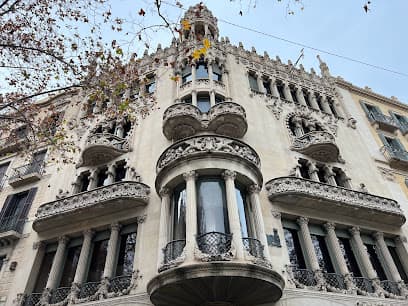
This is the work of Lluís Domènech i Montaner, the man who designed the Palau de la Música Catalana and arguably the only architect with enough stones to challenge Gaudí’s dominance. Unlike Gaudí’s trippy, organic hallucinations, Domènech i Montaner’s work is a more disciplined kind of madness. It’s a 'total work of art' where every square inch of stone, ceramic, and wood was touched by a master craftsman. The name itself is a pun—Lleó (lion) and Morera (mulberry tree)—motifs you’ll see carved into the facade with a level of detail that makes modern construction look like a child playing with Legos.
But here’s the thing about Barcelona: it’s a city that loves its history but isn’t afraid to sell it to the highest bidder. For decades, the ground floor of this masterpiece was butchered. In 1943, a misguided renovation saw the magnificent ground-floor sculptures—nymphs holding then-modern inventions like the phonograph and the camera—literally smashed to pieces with hammers. Why? Because they wanted more window space for a shop. It’s a tragedy that still stings for anyone who gives a damn about heritage. Today, the ground floor is occupied by Loewe, a luxury leather goods brand. It’s a strange juxtaposition—high-end handbags sitting where stone nymphs once stood—but that’s the reality of Eixample. It’s a living, breathing, commercial beast.
Inside, the house is an absolute clinic in craftsmanship. We’re talking about stained glass that filters the Mediterranean light into something holy, and woodwork so intricate it looks like it was grown rather than carved. However, unlike its neighbors, Casa Lleó Morera isn't always open for the standard 'shuffle-through-with-an-audioguide' tour. It’s often closed to the general public or restricted to private events and offices. This gives it an air of mystery that the more famous houses lack. It isn't a theme park; it’s a survivor.
When you stand across the street, ignore the tour buses for a second. Look at the top of the building—the stone pavilion that looks like a crown. It was destroyed during the Spanish Civil War and painstakingly rebuilt. It’s a testament to the city’s resilience. This building doesn’t scream for your attention like the Batlló; it demands your respect. It’s for the traveler who wants to see the nuance in the stone, the person who understands that the 'other' guy in the rivalry might have actually been the one with the better taste.
Is it worth the walk? Absolutely. Even if you can’t get inside, the facade alone is a better education in Catalan identity than a dozen museum tours. It’s beautiful, it’s scarred, and it’s unapologetically elite. It’s Barcelona in a nutshell.
Type
Tourist attraction
Duration
30-45 minutes (exterior and ground floor)
Best Time
Early morning or late afternoon when the sun hits the facade, highlighting the stone carvings without the midday crowds.
What People Say
building(22)1902(4)1864(3)casa batlló(3)1906(3)ceramic(3)stained glass windows(2)gaudi(2)
Features
Tourist attraction
Categories
ArchitectureModernismeHistory
Must-See Highlights
The stone 'crown' pavilion at the very top of the building
The mulberry and lion motifs hidden throughout the facade carvings
The ornate balconies that survived the 20th-century renovations
The preserved stained glass visible from the street
Visitor Tips
Don't just look at the ground floor; cross the street to see the full scale of the rooftop pavilion.
Enter the Loewe store even if you aren't buying anything; it's the only way to see the interior craftsmanship currently.
Compare the facade to Casa Amatller next door to see the difference between the Gothic-inspired and Floral-inspired Modernisme.
Good For
Architecture loversHistory buffsPhotography enthusiasts
Why Visit
The most intricate facade in the Manzana de la Discordia, featuring symbolic lion and mulberry motifs.
A rare example of a 'total work of art' where dozens of master craftsmen collaborated on every detail.
The ground floor houses a stunning Loewe flagship store, blending luxury retail with historic preservation.
Nearby Landmarks
- 1-minute walk from Casa Batlló
- 1-minute walk from Casa Amatller
- 2-minute walk from Passeig de Gràcia Metro
- 10-minute walk from Plaça de Catalunya
Accessibility
- Ground floor (Loewe store) is accessible
- Upper floors have limited accessibility due to historical structure
Location
Pg. de Gràcia, 35
Eixample, Barcelona
Nearby Hotels
Nearby Restaurants
In Eixample
ATTRACTION
Mural Margalef
Eixample
A towering splash of Mediterranean blue breaking the rigid geometry of Eixample, Joan Margalef’s mural is a visceral reminder that Barcelona’s soul isn't just in its museums.
0.0(0)
Tourist attraction
ATTRACTION
Mural Margalef
Eixample
A geometric middle finger to urban decay, this massive kinetic mural by Eduard Margalef turns a drab Eixample blind wall into a rhythmic, shifting explosion of optical art.
0.0(0)
Tourist attraction
ATTRACTION
Happy Foodies
Eixample
Forget the plastic-wrapped tourist traps; this is a deep dive into the grease, garlic, and soul of Catalan cooking where you actually learn to handle a knife and a porrón.
0.0(0)
Sightseeing tour agencyTour agency
Frequently Asked Questions
Is Casa Lleó Morera worth visiting?
Yes, but primarily for the facade. While the interior is a masterpiece of Modernisme, it is currently closed for regular public tours and mostly used for private events or offices.
What is the Block of Discord?
It is a famous section of Passeig de Gràcia featuring three competing architectural styles by Gaudí, Puig i Cadafalch, and Domènech i Montaner, all built for rival wealthy families.
Can you go inside Casa Lleó Morera?
As of 2024-2025, interior visits are generally restricted. You can visit the Loewe store on the ground floor to see some preserved architectural elements, but the upper floors are not typically open to the public.
Who designed Casa Lleó Morera?
It was designed by Lluís Domènech i Montaner, one of the most influential Catalan Modernista architects, also known for the Palau de la Música Catalana.
Reviews
0 reviews for Casa Lleó Morera
No reviews yet. Be the first to share your experience!