4.5
522 verified reviews
About
Barcelona is a city currently being choked to death by its own fame. You’ve seen the lines at the Sagrada Família; you’ve seen the throngs of people holding up selfie sticks in front of Casa Batlló like they’re worshipping a neon-lit altar of tourism. But if you want to see what happens when the late-stage Modernisme movement really went off the rails—without the €35 entry fee and the soul-crushing crowds—you head to the intersection of Avinguda Diagonal and Carrer de Còrsega. This is Casa Comalat, and it is an architectural personality disorder rendered in stone, wood, and ceramic.
Built between 1906 and 1911 by Salvador Valeri i Pupurull, a man who clearly looked at Gaudí’s work and thought, 'Hold my vermouth,' Casa Comalat is a tale of two cities. On the Diagonal side, the building wears a mask of bourgeois respectability. It’s formal, symmetrical, and carved from heavy stone. It’s got that grand, Eixample ego—the kind of place where a 20th-century industrialist would keep his secrets and his mistress. The balconies are ornate, the door is massive, and the whole thing screams 'old money.' It’s impressive, sure, but it’s the back side that tells the real story.
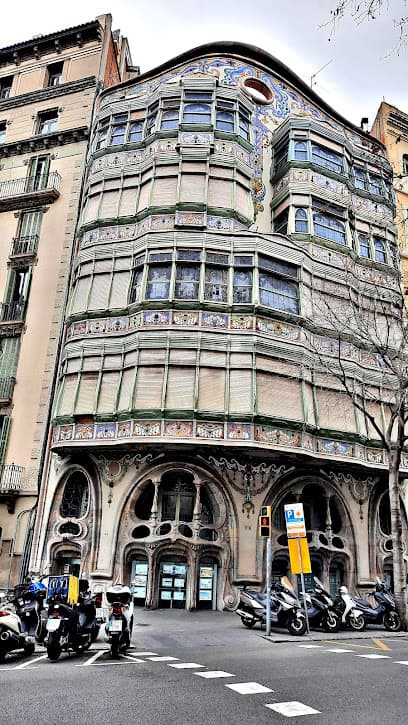
Walk around the corner to Carrer de Còrsega, and the building lets its hair down in a way that’s almost indecent. This is the 'party in the back' of Barcelona architecture. The facade undulates like a living thing, covered in a riot of polychrome ceramics and trencadís—those broken tile mosaics that define the best Modernisme Barcelona has to offer. The wooden galleries are curved and warped, and the green ceramic shutters look less like window coverings and more like the scales of a sleeping dragon. It’s a visceral, jarring contrast. It’s as if the building spent all day at a funeral on Diagonal and then spent the night at a rave on Còrsega.
Now, here is the honest truth: you can’t go in. Casa Comalat is a private residence, which is both a blessing and a curse. It’s a curse because you’ll spend ten minutes staring at that magnificent, heavy wooden door, wondering what kind of stained glass and wrought iron madness lies behind it. It’s a blessing because it remains one of the few truly authentic things to do in Eixample that hasn’t been turned into a gift shop. There are no audio guides here. No one is trying to sell you a miniature ceramic lizard. It’s just you, the street noise, and a building that looks like it was designed during a fever dream.
Is Casa Comalat worth visiting? If you give a damn about architecture that has actual balls, then yes. It’s a reminder that Modernisme wasn’t just about pretty flowers and soft curves; it was about ego, experimentation, and a total disregard for the 'sensible.' It’s one of the best things to see near Passeig de Gràcia if you’re tired of the polished, sanitized version of the city. You stand on the sidewalk, you look up, and you realize that even a hundred years ago, Barcelona was a city that refused to be boring. It’s a quiet, beautiful middle finger to the bland glass boxes of the modern world. Grab a coffee at a nearby café, find a spot on the pavement, and just stare at the Còrsega side for a while. It’s the best free show in town.
Type
Heritage building, Historical landmark
Duration
15-30 minutes
Best Time
Late afternoon for the best light on the Còrsega facade
What People Say
facade(19)modernisme(10)door(10)1911(7)color(7)photography(7)beauty(7)private property(4)
Features
Heritage building
Historical landmark
Tourist attraction
Categories
ModernismeArchitectureHeritage building
Ticket Prices
Free Admission
No tickets required
Must-See Highlights
The 'back' facade on Carrer de Còrsega with its green ceramic shutters
The undulating wooden galleries that look like waves
The ornate stone carvings on the Diagonal entrance
The trencadís mosaic work under the balconies
Visitor Tips
Don't just look at the Diagonal side; the real magic is around the back on Carrer de Còrsega
Bring a zoom lens to capture the intricate ceramic details on the upper floors
Combine this with a visit to the nearby Palau Robert gardens for a quiet break
Good For
Architecture buffsPhotographersBudget travelersGaudí fans looking for something different
Why Visit
Dual-facade design with a formal stone front and a colorful, undulating ceramic back
Masterpiece by Salvador Valeri i Pupurull, a contemporary of Gaudí with a wilder aesthetic
One of the few major Modernisme landmarks in Eixample that remains a private, non-commercialized residence
Nearby Landmarks
- 5-minute walk from Casa de les Punxes
- 7-minute walk from Palau Robert
- 10-minute walk from Passeig de Gràcia
- 12-minute walk from Casa Milà (La Pedrera)
Accessibility
- Street-level viewing
- Sidewalks are wheelchair accessible
Location
Av. Diagonal, 442
Eixample, Barcelona
Nearby Hotels
Nearby Restaurants
In Eixample
ATTRACTION
Mural Margalef
Eixample
A towering splash of Mediterranean blue breaking the rigid geometry of Eixample, Joan Margalef’s mural is a visceral reminder that Barcelona’s soul isn't just in its museums.
0.0(0)
Tourist attraction
ATTRACTION
Mural Margalef
Eixample
A geometric middle finger to urban decay, this massive kinetic mural by Eduard Margalef turns a drab Eixample blind wall into a rhythmic, shifting explosion of optical art.
0.0(0)
Tourist attraction
ATTRACTION
Happy Foodies
Eixample
Forget the plastic-wrapped tourist traps; this is a deep dive into the grease, garlic, and soul of Catalan cooking where you actually learn to handle a knife and a porrón.
0.0(0)
Sightseeing tour agencyTour agency
Frequently Asked Questions
Is Casa Comalat worth visiting?
Yes, absolutely, but only for the exterior. It features two completely different facades that represent the peak of late Modernisme creativity without the tourist crowds of Gaudí's houses.
Can you go inside Casa Comalat?
No, Casa Comalat is a private residential building. Visitors are restricted to viewing the stunning facades from the street on both Avinguda Diagonal and Carrer de Còrsega.
What is the best time to see Casa Comalat?
Visit in the late afternoon. The light hits the colorful ceramics and wooden galleries on the Carrer de Còrsega side perfectly, making the colors pop for photos.
How do I get to Casa Comalat?
Take the Metro (L3 or L5) to the Diagonal station. It is a short 5-minute walk from the station at the intersection of Av. Diagonal and Carrer de Còrsega.
Reviews
0 reviews for Casa Comalat
No reviews yet. Be the first to share your experience!