About
Barcelona is a city that has been curated to death. You walk down the Passeig de Gràcia and you’re buffeted by the winds of high-end retail and the elbows of ten thousand tourists trying to get the same photo of Casa Batlló. It’s exhausting. But if you walk a few blocks away, into the heart of the Eixample’s grid, you find the real bones of the city. You find places like Casa Antoni Piera. It’s not a circus. There’s no gift shop. It’s just a massive, beautiful, slightly arrogant statement of intent sitting at Carrer de Còrsega, 239.
This is the work of Enric Sagnier i Villavecchia. If Antoni Gaudí was the hallucinogenic poet of Catalan architecture, Sagnier was the architect of the establishment. He was the guy the wealthy families called when they wanted something that looked expensive, felt permanent, and didn't look like it was melting. Sagnier built more in this city than almost anyone else, yet his name is often whispered while Gaudí’s is shouted. Casa Antoni Piera, finished around 1906, is a prime example of why Sagnier was the go-to guy for the 20th-century bourgeoisie.
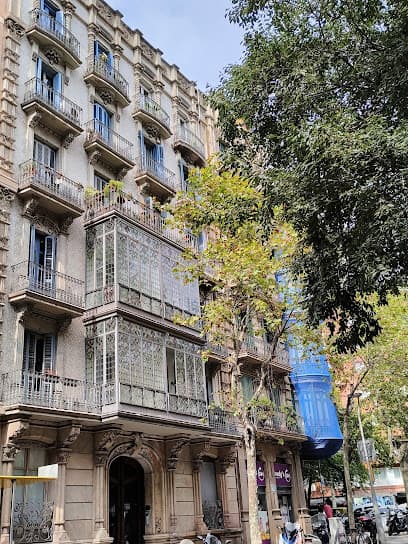
Standing on the sidewalk, you’re looking at a facade that demands you pay attention. It’s built from Montjuïc stone, the same stuff that gives the city its grey, muscular character. The ground floor is all about those grand, sweeping arches—the kind of entrance that says 'someone important lives here.' Look up and you see the balconies, heavy with wrought iron and stone carvings that lean into the Modernisme movement without losing their minds. It’s got that Neo-Gothic edge that Sagnier loved, a bit of medieval toughness mixed with the floral, flowing lines of Art Nouveau. It’s a protein-heavy architectural meal, solid and satisfying.
The tragedy, or perhaps the beauty, of Casa Antoni Piera is that it remains a private residential building. You can’t go inside and poke around the hallways. You can’t see the original elevators or the tiled kitchens where generations of Catalan families have argued over dinner. You are relegated to the street, a voyeur looking at a masterpiece from the 1900s while the 2025 traffic hums behind you. But there’s something honest about that. It’s not a museum piece preserved in amber; it’s a working part of the Eixample. People live here. They hang their laundry, they burn their toast, and they walk through those magnificent doors every day without thinking twice about the genius of the stone above their heads.
If you’re looking for the best Modernisme Barcelona has to offer without the soul-crushing queues, this is your spot. It’s a quiet corner of the Quadrat d'Or, the Golden Square, where the architecture feels like it belongs to the neighborhood rather than the tourism board. It’s a reminder that the Eixample was built on the back of industrial wealth and a desperate need for beauty. Is it worth the walk? If you care about the soul of a city, the answer is always yes. You don't need a ticket to appreciate the way the afternoon light hits that carved stone. You just need to stand there, shut up, and look up.
Type
Tourist attraction
Duration
15-30 minutes
Best Time
Late afternoon when the sun hits the facade, highlighting the stone carvings.
Features
Tourist attraction
Categories
ArchitectureModernismeHistoric Building
Ticket Prices
Free Admission
No tickets required
Must-See Highlights
The massive stone arches of the ground floor entrance
The intricate wrought-iron balcony railings
The sculptural floral motifs carved into the Montjuïc stone facade
The rhythmic symmetry of the upper floor windows
Visitor Tips
Combine this with a walk down Carrer d'Enric Granados for some of the city's best cafes.
Bring a zoom lens if you're a photographer; the best details are on the upper balconies.
Don't try to enter the building; it's a private residence and the neighbors value their privacy.
Good For
Architecture loversPhotography enthusiastsBudget travelersSolo travelers
Why Visit
Masterpiece by Enric Sagnier, the architect of the Catalan bourgeoisie
Located in the quiet, authentic heart of the Eixample's 'Golden Square'
Stunning example of 1904 stone-carved Modernisme with Neo-Gothic influences
Nearby Landmarks
- 5-minute walk from Hospital Clínic
- 8-minute walk from Rambla de Catalunya
- 10-minute walk from Avinguda Diagonal
- 12-minute walk from Casa Milà (La Pedrera)
Accessibility
- Viewable from the public sidewalk
- Flat terrain in the surrounding Eixample neighborhood
Location
Carrer de Còrsega, 239
Eixample, Barcelona
Nearby Hotels
Nearby Restaurants
In Eixample
ATTRACTION
Mural Margalef
Eixample
A towering splash of Mediterranean blue breaking the rigid geometry of Eixample, Joan Margalef’s mural is a visceral reminder that Barcelona’s soul isn't just in its museums.
0.0(0)
Tourist attraction
ATTRACTION
Mural Margalef
Eixample
A geometric middle finger to urban decay, this massive kinetic mural by Eduard Margalef turns a drab Eixample blind wall into a rhythmic, shifting explosion of optical art.
0.0(0)
Tourist attraction
ATTRACTION
Happy Foodies
Eixample
Forget the plastic-wrapped tourist traps; this is a deep dive into the grease, garlic, and soul of Catalan cooking where you actually learn to handle a knife and a porrón.
0.0(0)
Sightseeing tour agencyTour agency
Frequently Asked Questions
Is Casa Antoni Piera worth visiting?
Yes, if you are an architecture enthusiast looking for authentic Modernisme without the crowds. While you can only view the exterior, the intricate stone carvings and Sagnier's design make it a significant stop in the Eixample.
Can you go inside Casa Antoni Piera?
No, the building is a private residence and is not open to the public for interior tours. Visitors must appreciate the architectural details from the sidewalk.
Who was the architect of Casa Antoni Piera?
The building was designed by Enric Sagnier i Villavecchia, one of Barcelona's most prolific architects who designed over 300 buildings in the city, including the Temple Expiatori del Sagrat Cor on Tibidabo.
How do I get to Casa Antoni Piera?
The building is located at Carrer de Còrsega, 239. The nearest metro stations are Hospital Clínic (L5) and Diagonal (L3, L5), both about a 5-10 minute walk away.
Reviews
0 reviews for Casa Antoni Piera
No reviews yet. Be the first to share your experience!