4.0
1 verified reviews
About
Everyone knows the other one. You know the one I mean—the shimmering, skeletal, dragon-backed fever dream on Passeig de Gràcia that draws crowds thick enough to choke a horse. But if you walk a few blocks away, over to Carrer de Mallorca, you’ll find the quiet cousin. This is Casa Àngel Batlló. It doesn’t scream for your attention. It doesn’t have a gift shop selling overpriced kaleidoscopes. It just sits there, a stoic, red-brick reminder of what the Eixample looked like before it became a high-end theme park for the global elite.
Built between 1891 and 1896, this place is the work of Josep Vilaseca i Casanovas. If that name doesn’t ring a bell, his most famous work certainly will: the Arc de Triomf. While Gaudí was busy channelling the divine and the organic, Vilaseca was working with the earth. He was a master of the brick, the iron, and the ceramic. Casa Àngel Batlló is actually two buildings—numbers 253 and 257—joined together in a way that feels solid, permanent, and deeply rooted in the Catalan soil. It’s an example of early Modernisme, a transition point where the city was shaking off its medieval shackles and trying on a new, industrial identity.
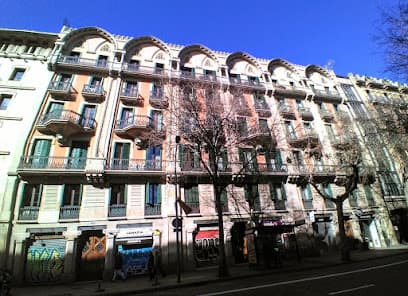
Look at the facade. It’s not the melting stone of the later movement. It’s precise. The red brickwork is punctuated by ceramic details that look like they were placed there by someone who actually gave a damn about the craft. There’s a Neo-Mudejar influence here—a nod to the Islamic architecture of Spain’s past—blended with the rising tide of European eclecticism. The ironwork on the balconies isn't whimsical; it’s heavy and functional, the kind of stuff that looks like it could survive a siege. It’s beautiful, sure, but it’s a rugged, unvarnished beauty. It’s the architectural equivalent of a well-worn leather jacket.
The Batlló family were textile magnates, the kind of people who built this city with smoke and looms. Àngel Batlló y Sunyol, the man who commissioned this, was the cousin of Josep Batlló—the guy who eventually hired Gaudí to renovate his own place. You can almost feel the family dynamic in the architecture. While Josep went for the flamboyant and the strange, Àngel went for something that felt like a fortress of good taste. It’s a house for a man who wanted you to know he was rich, but also that he was serious.
Today, the building remains a private residence. You can’t go inside. You can’t climb the stairs or poke around the bedrooms. And honestly? That’s part of the charm. In a city where every square inch of history has been monetized and packaged for consumption, there is something deeply satisfying about a masterpiece that asks nothing of you but a few minutes of your time from the sidewalk. You stand there, dodging the locals carrying their groceries and the occasional delivery bike, and you just look.
You see the wear and tear. You see the soot of the Eixample on the bricks. You see the reality of a building that is being lived in, not just looked at. It’s a palate cleanser. After the sensory overload of the big-ticket landmarks, Casa Àngel Batlló is the cold glass of water you didn't know you needed. It’s a reminder that Barcelona isn't just a museum; it’s a place where people have been living, working, and building monuments to their own egos for centuries. If you want the truth of the city, skip the line at the dragon house and come stand on this corner for a while. It’s free, it’s honest, and it’s spectacular.
Type
Tourist attraction
Duration
15-30 minutes
Best Time
Morning or late afternoon for the best light on the red brick facade without the midday sun glare.
Features
Tourist attraction
Categories
ArchitectureModernismeHistoric Site
Ticket Prices
Free Admission
No tickets required
Must-See Highlights
The intricate red brickwork and ceramic ornamentation
The heavy, ornate ironwork on the balconies
The dual-facade structure spanning numbers 253 and 257
The Neo-Mudejar architectural details
Visitor Tips
Combine this with a visit to Palau Montaner nearby, also designed by Vilaseca.
Look up at the top floor to see the more delicate ceramic work that is often missed.
Don't try to enter the building; it is a private residence and there is no public access.
Good For
Architecture enthusiastsPhotographersBudget travelersHistory buffs
Why Visit
Designed by Josep Vilaseca i Casanovas, the architect behind Barcelona's iconic Arc de Triomf
A rare, authentic example of early Modernisme that remains a functioning residential building
Zero crowds compared to the major Gaudí landmarks just a few blocks away
Nearby Landmarks
- 5-minute walk from Casa Milà (La Pedrera)
- 7-minute walk from Casa Batlló (Gaudí)
- 2-minute walk from Palau Montaner
- 4-minute walk from Passeig de Gràcia
Accessibility
- Viewable from the public sidewalk
- Flat terrain in the surrounding Eixample district
Location
Carrer de Mallorca, 253, 257
Eixample, Barcelona
Nearby Hotels
Nearby Restaurants
In Eixample
ATTRACTION
Mural Margalef
Eixample
A towering splash of Mediterranean blue breaking the rigid geometry of Eixample, Joan Margalef’s mural is a visceral reminder that Barcelona’s soul isn't just in its museums.
0.0(0)
Tourist attraction
ATTRACTION
Mural Margalef
Eixample
A geometric middle finger to urban decay, this massive kinetic mural by Eduard Margalef turns a drab Eixample blind wall into a rhythmic, shifting explosion of optical art.
0.0(0)
Tourist attraction
ATTRACTION
Happy Foodies
Eixample
Forget the plastic-wrapped tourist traps; this is a deep dive into the grease, garlic, and soul of Catalan cooking where you actually learn to handle a knife and a porrón.
0.0(0)
Sightseeing tour agencyTour agency
Frequently Asked Questions
Is Casa Àngel Batlló worth visiting?
Yes, if you appreciate architecture without the crowds. It is a stunning example of early Modernisme by the architect of the Arc de Triomf, though you can only view it from the exterior.
Can you go inside Casa Àngel Batlló?
No, the building is a private residential property and is not open to the public for interior tours. The attraction is the magnificent facade.
How does it differ from Gaudí's Casa Batlló?
While both were built for members of the same family, this house was designed by Josep Vilaseca i Casanovas in a more structured, red-brick Modernista style, whereas Gaudí's version is famous for its organic, skeletal forms.
How do I get to Casa Àngel Batlló?
It is located at Carrer de Mallorca, 253-257. The nearest metro stations are Passeig de Gràcia (L2, L3, L4) and Diagonal (L3, L5), both about a 5-minute walk away.
Reviews
0 reviews for Casa Àngel Batlló
No reviews yet. Be the first to share your experience!