4.6
3,930 verified reviews
About
Most people standing on the Passeig de Gràcia are staring, mouths agape, at the wavy, skull-masked hallucination that is Casa Batlló. They’re missing the point. Right next door, standing like a dignified, slightly eccentric uncle, is Casa Amatller. This isn't just another stop on the 'best Modernisme Barcelona' circuit; it’s a monument to the ego of a chocolate tycoon and the genius of Josep Puig i Cadafalch, the man who dared to be different in a neighborhood already losing its mind to architectural excess.
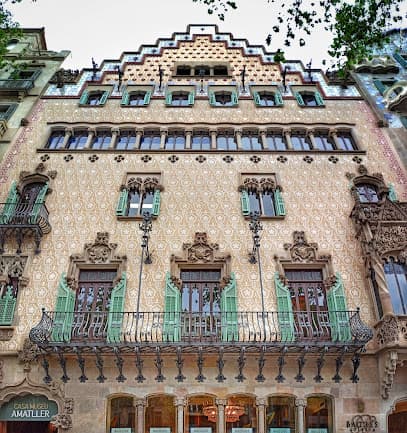
You walk up to a facade that looks like a Dutch canal house took a wrong turn at the Pyrenees and decided to dress up in Catalan ceramics. It’s part of the 'Manzana de la Discordia'—the Block of Discord—where the city’s three greatest architects basically engaged in a high-stakes pissing contest to see who could build the most outrageous mansion. While Gaudí went for the organic and the weird, Puig i Cadafalch went for the intricate. The stepped gable at the top is a middle finger to the boring straight lines of the Eixample, covered in tiles that shimmer like a box of expensive pralines.
Inside, the air changes. It doesn’t feel like a museum where history has been bleached out for the tourists. It feels like Antoni Amatller just stepped out for a smoke. He was a man of the world—a photographer, a traveler, and the guy who turned cocoa into a Catalan empire. The house is packed with his collection of Roman glass and Spanish art, including works by Sorolla that actually belong on these walls, not just hung there for prestige. The stained glass in the dining room filters the Barcelona sun into something moody and amber, the kind of light that makes you want to sit down and plot a corporate takeover or a revolution.
Everything here is a flex. The carved stone, the wrought iron, the elaborate woodwork—it was all paid for by the chocolate bars that fueled the industrial revolution in this city. It’s a sensory overload of the best kind, where every doorknob and floor tile was designed to scream 'I have arrived.' But unlike the neighbor’s house, which can feel like being trapped inside a giant ceramic lung, Casa Amatller has a grounded, masculine elegance. It’s the house of a man who appreciated the finer things but still knew how to run a factory.
And then there’s the payoff. You don’t leave through a gift shop selling plastic magnets. You end up in the old kitchens, now a café called Faborit, where you can get a cup of the legendary Amatller hot chocolate served with thick slices of toasted bread. It’s rich, dark, and unapologetically heavy—the kind of thing that would have kept a 19th-century industrialist going through a long winter. It’s the physical manifestation of the house itself: dense, high-quality, and deeply satisfying.
Is Casa Amatller worth it? If you want to understand the real Barcelona—the one built on trade, ambition, and a healthy dose of architectural rivalry—then yes. It’s less crowded than the Gaudí houses, the audio guide actually tells a coherent story, and you get fed at the end. It’s the thinking person’s Modernisme, and it’s one of the few places on this high-rent street that still feels like it has a soul.
Type
Museum, Tourist attraction
Duration
1-1.5 hours
Best Time
Morning around 10:00 AM to avoid the Passeig de Gràcia midday rush and secure a quiet table in the café.
Guided Tours
Available
Audio Guide
Available
What People Say
casa batllo(133)sorolla(118)modernisme(96)hot chocolate(92)gaudi(75)casa mila(43)facade(42)chocolatier(30)
Features
Museum
Tourist attraction
Categories
ArchitectureModernismeHistoryArt Museum
Ticket Prices
adult€17
child€14.45
senior€14.45
Opening Hours
- Monday10 AM to 7 PM
- Tuesday10 AM to 7 PM
- Wednesday10 AM to 7 PM
- Thursday10 AM to 7 PM
- Friday10 AM to 7 PM
- Saturday10 AM to 7 PM
- Sunday10 AM to 7 PM
Must-See Highlights
The stained-glass skylight in the entrance hall
Antoni Amatller's private collection of Roman glass
The original dining room with its intricate woodwork and fireplace
The Faborit café in the former kitchen area for the hot chocolate
Visitor Tips
The audio guide is excellent and included in the base price; don't skip it as the house's details are easy to miss without context.
Check the schedule for guided tours in English if you want to see the upper floors not always open to general admission.
The chocolate shop at the exit sells beautifully designed tins that make for the only non-tacky souvenirs in the neighborhood.
Good For
Architecture buffsHistory loversChocolate enthusiastsCouplesPhotography fans
Why Visit
The only house in the Block of Discord with its original furniture and owner's art collection intact
Designed by Josep Puig i Cadafalch, featuring a unique Flemish-inspired stepped gable facade
On-site chocolate shop and café serving the original 19th-century Amatller family recipes
Nearby Landmarks
- 1-minute walk from Casa Batlló
- 2-minute walk from Casa Lleó i Morera
- 5-minute walk from Plaça de Catalunya
- 10-minute walk from Casa Milà (La Pedrera)
Accessibility
- Elevator access available for the main floor tour
- Wheelchair accessible
- Accessible restrooms
Location
Pg. de Gràcia, 41
Eixample, Barcelona
Nearby Hotels
Nearby Restaurants
In Eixample
ATTRACTION
Mural Margalef
Eixample
A towering splash of Mediterranean blue breaking the rigid geometry of Eixample, Joan Margalef’s mural is a visceral reminder that Barcelona’s soul isn't just in its museums.
0.0(0)
Tourist attraction
ATTRACTION
Mural Margalef
Eixample
A geometric middle finger to urban decay, this massive kinetic mural by Eduard Margalef turns a drab Eixample blind wall into a rhythmic, shifting explosion of optical art.
0.0(0)
Tourist attraction
ATTRACTION
Happy Foodies
Eixample
Forget the plastic-wrapped tourist traps; this is a deep dive into the grease, garlic, and soul of Catalan cooking where you actually learn to handle a knife and a porrón.
0.0(0)
Sightseeing tour agencyTour agency
Frequently Asked Questions
Is Casa Amatller worth visiting compared to Casa Batlló?
Yes, especially if you hate crowds. It offers a more intimate look at a preserved 19th-century home with incredible art and history, plus it's generally cheaper and less chaotic than its famous neighbor.
What should I order at the Casa Amatller café?
The 'chocolate a la taza' (hot chocolate) served with traditional toasted bread is mandatory. It's based on the original Amatller family recipe and is arguably the best in the Eixample.
Do I need to book Casa Amatller tickets in advance?
While not as slammed as Gaudí sites, booking online is highly recommended to secure a specific time slot for the audio-guided or live-guided tours, which have limited capacity.
How long does a visit to Casa Amatller take?
Expect to spend about 60 to 90 minutes. This includes the tour of the main floor and time to enjoy a chocolate in the ground-floor café.
Reviews
0 reviews for Casa Amatller
No reviews yet. Be the first to share your experience!