5.0
9 verified reviews
About
Passeig de Gràcia is the catwalk of the Catalan bourgeoisie, a wide, sun-drenched boulevard where the ghosts of textile magnates still seem to sneer at your off-the-rack sneakers. It is a place of high-end fashion, overpriced coffee, and some of the most hallucinogenic architecture on the planet. But while everyone is craning their necks at the undulating stone of Casa Milà or the dragon-scaled roof of Casa Batlló, they often miss the very things they’re leaning against. I’m talking about the Bancs-fanals—the thirty-two modernist bench-lampposts that line the avenue like skeletal sentinels from a more ambitious age.
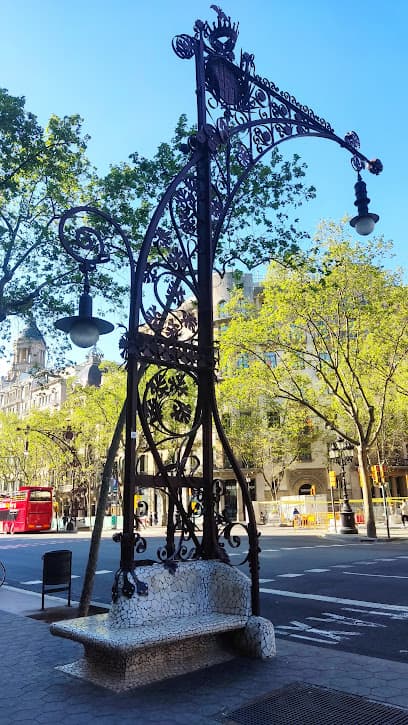
Designed in 1906 by Pere Falqués i Urpí, these aren't your standard-issue city council benches. They are a visceral middle finger to the mundane. Falqués, who was the municipal architect at the time, understood that in Barcelona, if you’re going to build something functional, you might as well make it look like it was forged in the fires of a fever dream. Each unit is a hybrid: a low, curving bench covered in white trencadís—those jagged shards of broken ceramic that define the city’s aesthetic—topped with a towering, ornate wrought-iron lamppost that looks like it’s trying to claw its way into the sky.
Sit down on one. The ceramic is cool, even when the Mediterranean sun is beating down on the asphalt. You’ll notice the ironwork isn't just decorative; it’s structural and organic, a tangle of bat-wing shapes, floral motifs, and the coat of arms of Barcelona. It was executed by the workshop of Manuel Ballarín, a man who treated iron like it was wet clay. There’s a heaviness to it, a sense of permanence that mocks the fleeting nature of the luxury shops behind you. These benches have seen everything: the flamboyant parades of the early 20th century, the dark days of the Civil War, the grey years of the dictatorship, and the current tidal wave of tourists armed with selfie sticks.
There is an honest grit here if you look for it. The white trencadís is stained by decades of city soot and the occasional spilled Estrella. The iron has been repainted more times than anyone can count. But the soul of the thing remains intact. Falqués was often overshadowed by the likes of Gaudí and Puig i Cadafalch, but with these benches, he brought high art down to the street level. He made it so that a weary laborer or a shopping-exhausted socialite could rest their bones on a piece of sculpture.
At night, when the yellow light flickers on, the Bancs-fanals transform. The shadows of the ironwork stretch across the pavement like ink blots, and for a second, the modern noise of the Eixample fades away. You’re left with the essential Barcelona—a city that refuses to be boring, even in its street furniture. It’s a reminder that beauty shouldn't be locked behind a museum paywall; it should be under your backside while you watch the world go by. If you’re looking for the best modernist architecture in Barcelona without the ticket lines, this is it. It’s free, it’s functional, and it’s been waiting for you since 1906. Don't just walk past. Sit down, shut up, and look at the ironwork.
Type
Tourist attraction
Duration
15-30 minutes
Best Time
Evening for the atmospheric lighting and fewer crowds.
What People Say
1906(2)architect(2)
Features
Tourist attraction
Categories
ArchitectureModernismePublic ArtHistory
Ticket Prices
Free Admission
No tickets required
Must-See Highlights
The intricate wrought-iron bat and floral motifs at the top of the lamps
The coat of arms of Barcelona integrated into the ironwork
The classic white trencadís (broken tile) mosaic on the seating area
Visitor Tips
These are active public benches; feel free to sit and people-watch.
Look closely at the base of the ironwork to see the craftsmanship of the Ballarín workshop.
Combine this with a walk to see the 'Manzana de la Discordia' just a few blocks away.
Good For
Architecture enthusiastsBudget travelersPhotographersHistory buffs
Why Visit
Original 1906 Modernist Street Furniture
Masterful Wrought-Iron Work by Manuel Ballarín
Iconic White Trencadís Mosaic Design
Nearby Landmarks
- 2-minute walk from Casa Batlló
- 5-minute walk from Plaça de Catalunya
- 8-minute walk from Casa Milà (La Pedrera)
- 4-minute walk from Fundació Antoni Tàpies
Accessibility
- Fully accessible (public sidewalk)
- Tactile surfaces
- Outdoor venue
Location
Pg. de Gràcia, 13
Eixample, Barcelona
Nearby Hotels
Nearby Restaurants
In Eixample
ATTRACTION
Mural Margalef
Eixample
A towering splash of Mediterranean blue breaking the rigid geometry of Eixample, Joan Margalef’s mural is a visceral reminder that Barcelona’s soul isn't just in its museums.
0.0(0)
Tourist attraction
ATTRACTION
Mural Margalef
Eixample
A geometric middle finger to urban decay, this massive kinetic mural by Eduard Margalef turns a drab Eixample blind wall into a rhythmic, shifting explosion of optical art.
0.0(0)
Tourist attraction
ATTRACTION
Happy Foodies
Eixample
Forget the plastic-wrapped tourist traps; this is a deep dive into the grease, garlic, and soul of Catalan cooking where you actually learn to handle a knife and a porrón.
0.0(0)
Sightseeing tour agencyTour agency
Frequently Asked Questions
Is it worth visiting the Bancs-fanals?
Absolutely, especially since they are free and located on one of the city's most famous streets. They offer a unique look at how Modernisme was applied to everyday street furniture, not just grand mansions.
Where exactly are the Pere Falqués benches located?
There are 32 of them lining both sides of Passeig de Gràcia, stretching from Plaça de Catalunya up towards Avinguda Diagonal in the Eixample district.
What is the best time to see the lampposts?
Visit at dusk or night when the lamps are lit. The wrought-iron shadows create a dramatic atmosphere that you miss during the bright daylight hours.
Who was the architect of the Passeig de Gràcia benches?
They were designed by Pere Falqués i Urpí in 1906, who served as Barcelona's municipal architect and was a contemporary of Antoni Gaudí.
Reviews
0 reviews for Bancs-fanals modernistes de Pere Falqués
No reviews yet. Be the first to share your experience!